BiQ: Weekly Recap for 11/08/26
Most of the information contained in this Weekly Recap has been previously discussed in the BiQ Chat forum. I encourage members who haven't joined BiQ Chat yet to join our Discord group. Instructions can be found here.
As most of us are probably aware, this was a very challenging week for investors. Markets initially reacted positively on Wednesday after Democrats swept national, state, and local elections across the country. However, by Thursday, fears around what the Democratic majority would do with its newfound power rocked the indexes: the DJI fell 3.44%, the S&P fell 4.36%, the Nasdaq fell a whopping 5.52%, and the Russell 2000 fell 4.54%.
The pain was felt most keenly in AI-related names, with names like NVDA and MU falling 9.26% and 17.46%, respectively. A key trigger for the AI selloff was surprise Democratic victories in the Texas and Ohio gubernatorial races, both key hubs for the AI data center buildout. AI names have led markets to new highs for most of this year. The sudden weakness in the sector likely contributed to broader market weakness, especially as many investors and hedge funds were caught off guard and may have been forced to deleverage quickly.
One bright spot, however, was gold. As previously discussed in BiQ Chat, I have been adding to my gold miner and royalty holdings opportunistically over the past year as I believe the sector, or at least the names in our portfolio, remain very attractively priced. On Thursday, Gold rose 0.65% while the GDX rose 1.37%, and the rally continued through Friday. I'm not sure, however, whether this was mostly a flight to safety and/or a reaction to dollar weakness, or a longer-term sector recovery. Either way, I believe our names remain attractively priced, and I plan to continue holding my positions.
I think volatility could continue in the near term as investors adapt to broad Democratic wins and what they could mean for the markets. My opinion, fwiw, is that this is an overall positive. Democrats do not hold a veto-proof majority, so they will still need to compromise with moderate Republicans to advance key legislation. However, with both chambers now under Democratic control, I think the added oversight could reduce what has become all-too-common political whiplash and, hopefully, increase pressure on the Administration to wind down its war in Iran and scale back on tariffs.
Section 1: Selected Weekly Highlights
Biotech
Kura Oncology
Shares of Kura Oncology (KURA) and Syndax Pharmaceuticals (SNDX) sold off sharply this past week after the publication of the ASH abstract for J&J's breximenib, a menin inhibitor the company is developing to treat KMT2A- and NPM1-mutated AML. In r/r patients, bleximenib showed an ORR of 47.6% and a composite CR of 38.1%, with a mDOR of 6.4 months. Composite CR was 33.3% in NPM1m (n=12). In addition, grade 3/4 DS was 6.5%, and grade 3 QTc prolongation occurred in only .7% of patients.
While the data are still early and the trial size is small, and though these are cross-trial comparisons, the data raise concerns that breximenib could emerge as a best-in-class drug across both NPM1m and KMT2Ar patients. Furthermore, the safety profile, with significantly lower rates of observed DS and QTc prolongation, could make breximenib a better agent for 1L combination therapies, positioning breximenib as a significant threat to both REVUFORJ and KOMZIFTI in r/r and 1L populations.
Here is my post from BiQ Chat earlier this week:
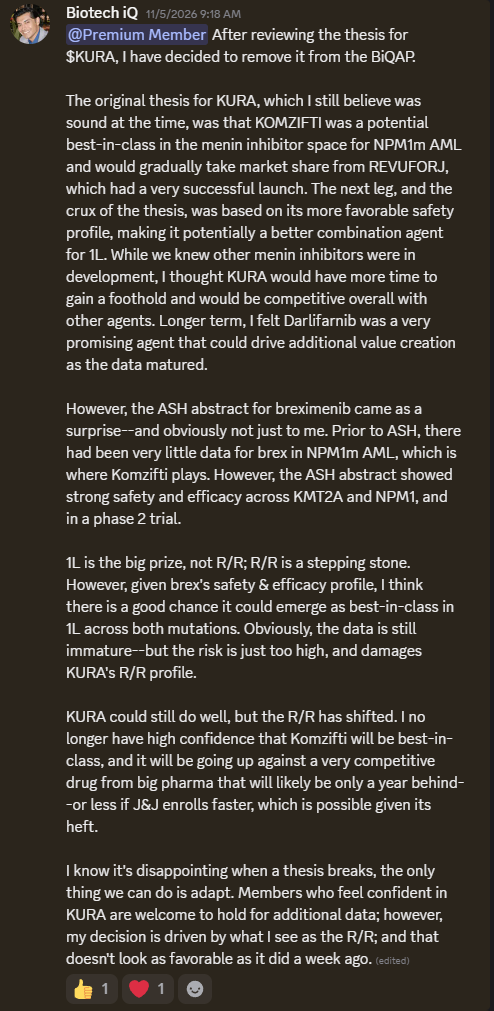
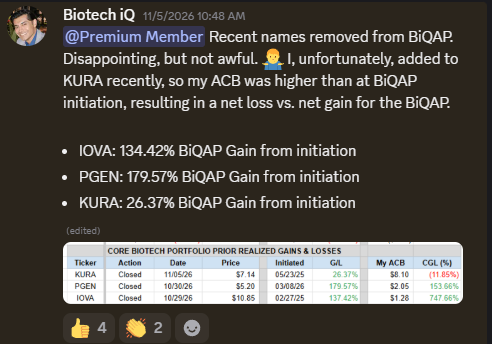
KURA is now the 3rd BiQAP name, following IOVA and PGEN, to be removed from the portfolio over the past two weeks based on new information. While it's disappointing when a thesis breaks, and although we've been fortunate enough not to have had many of these events at BiQ, we should remember that this is a normal part of investing in biotech. The only thing we can do is adapt.
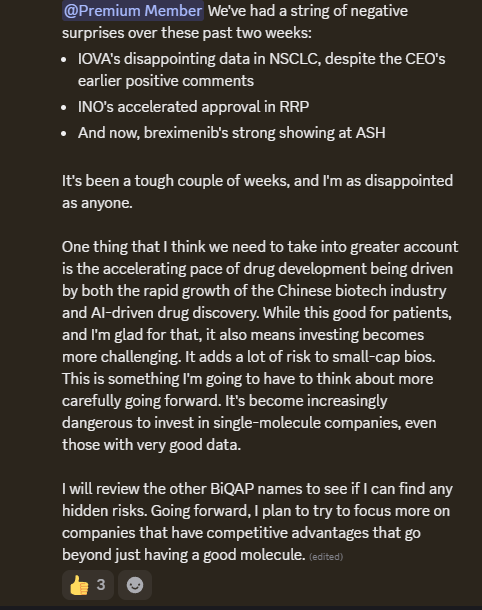
Still, we did quite well with all three names. Aside from the valuations, I still like them and plan to continue monitoring them in case the R/R starts to skew favorable again.
On a bright note, we also added a promising new name to the BiQAP after its shares pulled back 40%, which I consider an overreaction. Please see the Premium Member section for more information.
Verastem
Verastem’s (VSTM) third quarter was about VS-7375, or TARGET-D as it's now known, not the LGSOC launch. AVMAPKI FAKZYNJA CO-PACK net product revenue came in at $24.0 million, a little below Q2’s $25.1 million. Management said strong refill growth was partially offset by fewer new patient starts due to seasonal headwinds, commercial team changes, and evolving off-label use, and now expects a slower ramp. That’s worth noting, but the co-pack is a rare-disease product that helps fund the company. It isn’t the reason to own the stock.
The bigger story is TARGET-D. In October’s update, VS-7375 900 mg monotherapy posted a 50% confirmed ORR in 2L pancreatic cancer and 41% in 2L+, with an 86% disease control rate and 67% six-month landmark PFS. Lung and colorectal also showed activity: 43% cORR in 2L+ NSCLC, 75% ORR (6/8) in early 1L lung combined with chemo and pembrolizumab, and 33% ORR (2/6) in 3L+ CRC with anti-EGFR therapy. Tolerability remains a key differentiator. At 900 mg, AE-related discontinuations were 2%, median relative dose intensity was 97%, and Grade 3 TRAEs occurred in 10% of patients. The company also reached FDA alignment on TARGET-D 301, a three-arm Phase 3 in 1L pancreatic cancer testing VS-7375 with anti-EGFR therapy (a chemo-free arm) and with gemcitabine/nab-paclitaxel versus standard chemotherapy. That trial is expected to open by year-end, with FDA meetings on the CRC and NSCLC Phase 3 designs also planned before year-end.
The October raise gives Verastem the money to fund all of this. The company ended Q3 with $172.8 million, or $422.8 million pro forma including the $250 million offering, which it says funds operations into 1H 2028, including the start of three pivotal Phase 3 studies. Upcoming catalysts include mature mCRC combination data in Q1 2027, initial 1L pancreatic data with gem/nab-paclitaxel in early Q2 2027, and the first TARGET-D 201 Phase 2 data in 2L PDAC in Q2 2027. Leadership is also changing: Michael Bailey takes over as CEO on January 1, 2027, succeeding the retiring Dan Paterson.
Ceribell
Ceribell’s (CBLL) Q3 was mostly good. Revenue rose 30% year over year to $29.3 million, slightly ahead of the roughly $29.2 million consensus. The company added a record 35 net new accounts, bringing it to 747, and existing accounts showed double-digit same-store utilization growth. Gross margin reached 90%, helped by manufacturing cost reductions and the new Vietnam production line. Management also announced the full launch of its delirium monitoring product after the commercial pilot, and raised full-year 2026 revenue guidance to $115–117 million. That guidance still doesn’t include meaningful revenue from the neonatal, pediatric, or delirium products--which are probably 2027 stories.
The problem was spending. Operating expenses grew 36% to $46.9 million, faster than revenue, which widened the adjusted EBITDA loss to $12.1 million. The EPS loss of $0.55 also missed the $0.51 estimate. The stock had run up hard into the print, and the guidance raise was small, so shares opened at $22.05 the next morning after closing at $28.27, down about 22%. Buyers stepped in almost immediately, and CBLL finished the day at $27.39, down only about 3%.
However, keep in mind that the higher spending is going into the delirium launch, the next-generation hardware platform, and clinical work, all aimed at the 2027 growth story rather than signaling weakness in the core seizure business. That business is still growing about 30% with 90% gross margins. The company has $117.5 million in cash plus up to $60 million in committed credit capacity, so there is no near-term financing overhang. The key thing to watch is the initial 2027 guidance next quarter, which should show how much the new indications are expected to contribute.
Ultragenyx
Ultragenyx (RARE) also released Q3 earnings this past week. The key takeaway this quarter was cost reductions, not revenue. Investors got what they had been waiting for: meaningful cuts and a reasonable path to profitability. Total revenue was $173 million, versus $160 million a year ago. Crysvita contributed $109 million, and Dojolvi $30 million, and full-year guidance of $730–760 million was reaffirmed. That guidance excludes the newly approved gene therapies, GENGLYCOS for GSDIa and FAYUVI for Sanfilippo syndrome type A. Management says both launches are going well and demand is growing.
The restructuring goes well beyond the 10% cut announced in February. Headcount is being reduced by about 20%, to roughly 1,000 employees. The company is winding down all GTX-102 studies in Angelman syndrome after the disappointing Phase 3 and ending UX701 in Wilson disease. As a result, 2027 R&D is guided below $350 million, at least 50% lower than 2025, and SG&A below $375 million. Remaining R&D spending will go mainly to the DTX301 Phase 3 readout in OTC deficiency, expected in H1 2027, and to working out whether setrusumab has a regulatory path. Management reaffirmed full-year GAAP profitability in 2027 and beyond.
The balance sheet supports the plan. Ultragenyx ended the quarter with $401 million in cash and is selling the two priority review vouchers from the approvals for $413 million combined, which should bring in about $350 million net. That brings pro forma liquidity to roughly $750 million, which should get the company to profitability without raising new money. The cost side is now largely within management’s control. What remains is execution on the gene therapy launches, which will determine whether profits are meaningful or only marginal in 2027.
One caveat to this is that GAAP profitability will also have to absorb roughly $80 million a year in non-cash interest on the Crysvita royalty sales, so the 2027 target relies more on the launches than the cost cuts alone might initially suggest. This is something to watch carefully going forward.
Boston Scientific
Boston Scientific (BSX) had another difficult quarter. Sales rose 1.5% to $5.14 billion and adjusted EPS was $0.73, slightly above the $0.72 consensus. The headline, though, was the fourth guidance cut of the year. Full-year organic growth is now about 3.75%, down from 10–11% at the start of the year, and adjusted EPS guidance was lowered to $3.16–3.18 from $3.28–3.32. Q4 sales are now expected to decline 1–3%. Management said the August cyberattack cost about 300 bps of revenue growth and roughly $0.07 of EPS. That doesn’t explain everything, however. Electrophysiology fell 5% (U.S. down 8%) as pulsed field ablation competition intensifies, and Watchman declined 6%, with U.S. standalone procedures down in the high teens. Neuromodulation grew 13%, and interventional cardiology was reportedly strong, but the two franchises that drove the stock for years are now holding it back.
Shares fell as much as 12% intraday before recovering to about a 4% loss. That suggests much of the bad news was already priced into a stock that had fallen roughly 50% this year. The bigger concern is 2027. CEO Mike Mahoney said the company will struggle to grow sales and adjusted EPS next year, excluding the pending Penumbra acquisition. Farawave Ultra, the next-generation PFA catheter seen as the key to stabilizing EP share, has slipped to early 2028. In my view, the long-term portfolio is still strong, but investors should expect 2027 to be a transition year with little near-term catalyst support.
One positive came from TCT, where Boston Scientific presented six-month results from the 1,857-patient SIMPLAAFY trial, published at the same time in JAMA. After Watchman FLX Pro implantation, both aspirin alone and a reduced-dose NOAC met non-inferiority to dual antiplatelet therapy (DAPT) on the primary composite of death, stroke, systemic embolism, or major bleeding. Event rates were 3.3% for aspirin, 5.1% for reduced-dose NOAC, and 6.9% for DAPT. Clinically relevant bleeding was roughly halved on either monotherapy (3.8% and 4.8% vs. 8.7% for DAPT), and ischemic stroke was 0.7% in all three arms. A simpler, lower-bleeding post-implant regimen could make Watchman easier for physicians and patients to choose, which matters as the franchise loses momentum. That said, it addresses convenience rather than the competitive and reimbursement pressures behind the slowdown. A few caveats: the results apply to uncomplicated implants, event rates were lower than expected, and 12-month data are still to come.
Space, Aerospace, & Defense
Firefly Aerospace, AST SpaceMobile
It was a big week for two of my space holdings, and for once the main news involved both of them. On Nov. 6, AST SpaceMobile announced it will build its own reusable 20-ton rocket, Blacklift, to launch BlueBird satellites, powered by Firefly’s Miranda and Vira engines. Blacklift is designed to carry up to five BlueBirds per launch, beginning in late 2028. Firefly will supply engines for the first three rockets (27 Miranda and nine vacuum-variant Vira engines) and provide three years of engineering support. ASTS also gets a perpetual license to manufacture both engines at a new U.S. facility it will build.
The deal is worth more than $1.3 billion to Firefly. It breaks down as roughly $800 million upfront for the license ($400 million in cash plus 10–14 million ASTS shares), $250 million for the first three rockets’ engines, and $250 million for engineering services over three years.
Why it matters for ASTS: Launch access has been one of the biggest risks in the ASTS story. Deployment timelines have depended on other companies’ rockets, schedules, and priorities. Blacklift addresses that directly and completes the vertical integration management has long talked about, giving ASTS control of its own launch cadence and better economics per launch. Licensing a proven engine instead of designing one is the right choice. Miranda has completed more than 175 hot-fire tests, totaling over 4,200 seconds, and the engine is usually the hardest and riskiest part of building a rocket. Management says this lets ASTS skip much of the typical five-to-ten-year development cycle. ASTS isn’t dropping its existing launch partners either: current agreements cover more than 100 BlueBirds to be deployed in 2027–2028, so Blacklift adds capacity rather than replacing the existing plan.
That said, this is a large commitment with real execution risk. Building a rocket is hard even with an off-the-shelf engine. Between the cash and the 10–14 million new shares, the deal adds both capital spending and dilution, and Blacklift won’t contribute until late 2028 at the earliest. More details should come at the Blacklift unveiling event in New York on Nov. 12.
Why it matters for FLY: For Firefly, this is a transformational deal. At more than $1.3 billion, it is large relative to Firefly’s 2026 revenue guidance of $420–450 million, and it validates Miranda as one of the few proven liquid engines of this size in the U.S. Firefly keeps full ownership of the engine IP and will continue selling launch services to the broader market, with the deal structured so the two companies don’t compete. The proceeds will fund additional test bays at its Briggs, Texas Rocket Ranch, long-lead materials, and more engineers, speeding up Firefly’s own launch vehicle production. Part of the payment comes as ASTS stock with lock-ups, so Firefly also gains exposure to ASTS’s success. I’ll be watching the Q3 call on Nov. 10 for details on how the deal will be recognized.
In other FLY news, NASA selected Firefly as one of eight vendors for CLPS 2, a 10-year IDIQ contract with a combined maximum value of $10 billion for robotic lunar deliveries supporting the Moon Base program. To be clear, this makes Firefly eligible to compete for task orders; it is not a $10 billion award to Firefly. It competes alongside Blue Origin, Intuitive Machines, ispace-U.S., Lockheed Martin, Northrop Grumman, SpaceX, and Voyager. Still, Firefly enters CLPS 2 with a strong record. Since Blue Ghost Mission 1’s landing, it has won four more CLPS 1 missions plus the MoonFall delivery contract, and it is developing a larger lander for heavier cargo and infrastructure. In the same announcement, NASA said Firefly will supply in-space transportation spacecraft for some of the newly awarded Moon Base logistics missions.
Energy
Bloom Energy
California Resources (CRC) and its carbon management business, Carbon TerraVault (CTV), signed a non-binding MOU with Bloom (BE) to jointly evaluate building 1 GW or more of solid-oxide fuel cell generation paired with carbon capture and storage in California. Each company has a defined role. Bloom supplies the fuel cells and third-party carbon capture technology, CTV transports and permanently stores the CO2, and CRC manages the projects. Planned projects cover both front-of-the-meter generation selling to utilities and behind-the-meter sites across CRC’s Central Valley footprint serving on-site industrial users. Together, they could capture up to 3 million metric tons of CO2 per year. Potential customers include data centers, utilities, community choice aggregators, municipalities, and industrial users. BE rose 9% on the news.
The main benefit I see for BE is a path into California, a large market where it’s hard to permit new gas-fired power. Bloom’s pitch is that its non-combustion process produces a concentrated CO2 exhaust stream, which makes capture cheaper and more efficient than at a conventional gas plant. If that works at scale, gas-fueled fuel cells could become a near-zero-carbon product that can be sold where conventional gas generation can’t, which could be a real advantage as Democrats bring a renewed focus on carbon emissions. This is the second major carbon capture project for Bloom. AEP plans to use 700 MW of Bloom servers fitted for carbon capture in one project, and management called carbon capture a potential trillion-dollar opportunity on the October 22 call. CRC also provides things Bloom doesn’t have: land, subsurface storage, CO2 transport and storage expertise, and project development capability. That lets Bloom concentrate on supplying equipment rather than developing projects. The customer list is also broader than Bloom’s recent data center deals, which reduces how much the growth story depends on AI demand alone.
Keep in mind that this is an MOU, not an order. It is non-binding, has no financial terms, and still requires permitting, interconnection, offtake agreements, and regulatory approvals before any revenue arrives. I wouldn’t include it in near-term estimates until it turns into orders. Execution risk is real too: opposition to the gas pipeline meant to supply Project Jupiter's fuel cells has slowed the Oracle deployment, and California is unlikely to be any easier. Valuation also leaves little room for error. Even after falling 25% in the month before the announcement, BE trades at about 16.5x trailing sales and is still well below its June high of $345.85.
Overall, I see this as a meaningful strategic win but not yet a financial one. If the CRC partnership produces even part of the 1 GW in binding projects, it would prove that fuel cells with carbon capture can work in a strict, high-value power market. That model could then be repeated elsewhere, adding to Bloom’s existing pipeline, which includes the up-to-2.8 GW Oracle agreement and FY26 revenue guidance of $4.4–4.6 billion.
Information Technology
Qualcomm
Qualcomm (QCOM) beat on the quarter, but the stock fell nonetheless on its outlook. Non-GAAP revenue was $10.44 billion, at the top of the $9.7–10.5 billion guided range and ahead of consensus, and non-GAAP EPS of $2.17 was a penny above estimates. The weak spot was handsets: QCT handset revenue fell 26% year over year to $5.14 billion, because higher memory costs pushed up phone prices and the smartphone market shrank by a low- to mid-teens percentage this year. The diversification story kept getting stronger. Automotive revenue rose 89% to a record $1.99 billion, its first $2 billion quarter, and Qualcomm now has an automotive run rate of about $8 billion. Combined automotive and IoT revenue grew 36%. The company also renewed its long-term licensing agreements with Apple, Huawei, and Transsion, which keeps QTL’s run rate intact even as Apple modem sales go to zero.
Guidance is what hurt the stock. Fiscal Q1 non-GAAP EPS guidance of $2.15–2.35 was roughly in line, but GAAP EPS guidance of $1.03–1.23 was well below the $1.67 consensus. QCT margins are guided down to 20–22% from 24%, pressured by memory costs and the early, lower-margin data center ramp, and that squeeze is expected to last into mid-2027. Shares opened about 13% lower on Thursday before recovering to roughly a 10% decline. The timing didn’t help. The semiconductor index fell 11% that day, its worst session since March 2020, as election results raised concerns about the pace of AI data center construction. That broader AI selloff made Qualcomm’s guidance-driven move look worse than it otherwise would have.
I remain bullish on QCOM over the long term, but the next couple of quarters will likely be a transition period. Handsets will be a headwind until memory supply and pricing normalize, and management expects the smartphone market to be flat to slightly down in 2027. Meanwhile, the newer businesses are growing quickly: non-handset revenue is projected to grow more than 60% in FY27, autos are already at an $8 billion run rate, and the $5 billion FY27 data center target was reaffirmed. When handsets recover, Qualcomm should have a much more diversified growth base than it had going into this cycle. At about 15x FY26 non-GAAP earnings, I think the market is valuing a company in transition as if it were in decline.
Also, on Nov. 4, SpaceX (SPCX) chose Qualcomm’s Dragonwing Cellular Infrastructure platforms for Starlink Mobile’s planned nationwide U.S. terrestrial 5G network. The architecture combines the QRU100 radio unit and QDU100 distributed unit platforms with Qualcomm’s commercial-grade Layer 1 software to power 64T64R Massive MIMO radios. Under the multi-year agreement, SpaceX plans to deploy tens of thousands of sites starting in 2027. The terrestrial network is meant to complement Starlink’s satellite direct-to-device service as SpaceX moves toward competing with AT&T, Verizon, and T-Mobile. For Qualcomm, it is reportedly its largest 5G infrastructure win and a high-profile reference customer in a market led by Ericsson and Nokia. Revenue is not expected until late FY27, with FY28 more meaningful, and financial terms were not disclosed. The stock rose 5.3% on the news before earnings erased the gain. So this deal does nothing for the next few quarters of margin pressure, but in my opinion, it strengthens the long-term infrastructure story and adds another potential growth vector.
Micron Technology
The Information recently reported that TSMC (TSM) had begun drafting plans to manufacture 3D DRAM at the request of Nvidia, its largest customer. 3D DRAM stacks memory cells vertically instead of in a single flat layer, packing more capacity into the same footprint. The effort is reportedly led by Hsu Kuo-chin, a TSMC vice president who oversees advanced packaging and previously worked at Micron. TSMC was also said to be considering buying and converting an existing fab, which would give Nvidia a fourth memory supplier and more pricing leverage. The next day, a TSMC spokesperson told Tom’s Hardware that the company is focused on its core foundry business and intends to remain a logic-chip technology and capacity provider. That statement didn’t directly address whether the plans exist.
There is no official timeline, capacity target, or capital commitment. Realistically, any TSMC DRAM is many years away. TSMC has no DRAM process, IP, or production capacity, and 3D DRAM is still years from commercial viability even for the incumbents. Tom’s Hardware estimates the effort couldn’t ease shortages for at least five years, and Micron’s own roadmap includes at least four more generations of planar DRAM before it moves to 3D. Patents are another obstacle: Winbond’s chair called a direct TSMC entry into DRAM unlikely because of patent and process barriers.
In the near term, I see very little impact on Micron (MU). The memory shortage is expected to last into 2028, and UBS projects DRAM undersupply through at least Q2 2028. Even if TSMC moved ahead, its supply would arrive long after that. The more important signal is strategic. Nvidia, the largest buyer of high-end memory, is clearly looking for alternatives to the Samsung/SK Hynix/Micron oligopoly to gain leverage on supply and price. Over the long term, that could limit how much pricing power memory makers keep once shortages ease. On the other hand, TSMC is as much a Micron partner as a potential rival: Micron is working with TSMC on base logic dies for its HBM4E. Micron also has its own 3D DRAM program and a long head start in process technology. The more immediate supply risks to MU are Chinese capacity growth, such as CXMT’s recent technical progress, and faster HBM ramps at Samsung, not TSMC; however, this is something plan to watch closely.
Precious Metals
B2Gold
B2Gold’s Q3 was mixed. Cash flow and permitting improved, while operations were softer. Revenue rose to $836 million from $789 million in Q2, partly because the prepaid gold sales contracts ended in June, so every ounce now sells at market. The company sold 195,018 ounces at an average realized price of $4,289/oz. Headline net income was $409 million ($0.31/share), but that includes a $253 million impairment reversal at Fekola. Adjusted net income, the better measure, rose to $183 million ($0.14/share) from $41 million in Q2, even after $47 million of realized losses on gold collar hedges. Free cash flow turned positive at $48 million after a $258 million outflow in Q2. B2Gold ended the quarter with $294 million in cash and an undrawn $705 million revolver, and returned $59 million to shareholders, including $33 million in buybacks.
Operations were the weak spot. Production fell to 193,321 ounces, the lowest of the year, mainly because Fekola (78,119 oz) shifted to Phase 8 waste stripping, which will run through most of 2027. All-in sustaining costs rose to $2,602/oz from $2,356. Goose remains the problem asset at $4,816/oz: its mill is limited to about 3,200 tpd after April’s crusher fire, and management expects that rate to hold until mid-2027. Masbate and Otjikoto continue to outperform.
The most important strategic news was the Menankoto exploitation permit, which had been delayed for months. Waste stripping started in October, which reduces the risk to the Fekola Complex growth plan.
Full-year AISC guidance was cut to $2,230–2,410/oz from $2,370–2,550, while production guidance stays at 820,000–920,000 oz. Both depend on a strong Q4. With 634,732 oz produced year to date, B2Gold needs about 185,000 oz to reach the low end and about 235,000 oz for the midpoint, which is close to its Q1 output. Year-to-date AISC of $2,267 is within the new range, but Q3 alone was well above it, so the lower cost guidance is only credible if Q4 production comes in strong.
This quarter showed the free cash flow inflection starting to take hold. With the prepay contracts finished and gold above $4,000/oz, more of each ounce now turns into cash, and the move from a $258 million outflow to positive free cash flow in a single quarter shows that. The Menankoto permit was the overhang I was most focused on, and with it secured and stripping underway, the Fekola Complex growth plan is back on track. Goose is taking longer than hoped, and Fekola’s stripping phase will weigh on output into 2027, but I see those as timing issues rather than thesis-breakers. Masbate and Otjikoto continue to outperform, the balance sheet has plenty of liquidity, and the company is returning cash through buybacks and dividends while it works through these issues. Q4 production is the near-term test. Over the long term, I think B2Gold is well positioned to benefit from a strong gold price as Goose ramps toward its full potential and Fekola Regional comes online.
Section 2: Core Biotech Portfolio Performance
To view full portfolio performance across our entire portfolio of biotech and non-biotech names, including the related tickers, members can click here for the complete spreadsheet.
Portfolio Performance represents the gain/loss in the share price during the holding period.
My Performance represents my personal performance, which includes options and trading income realized during the holding period.
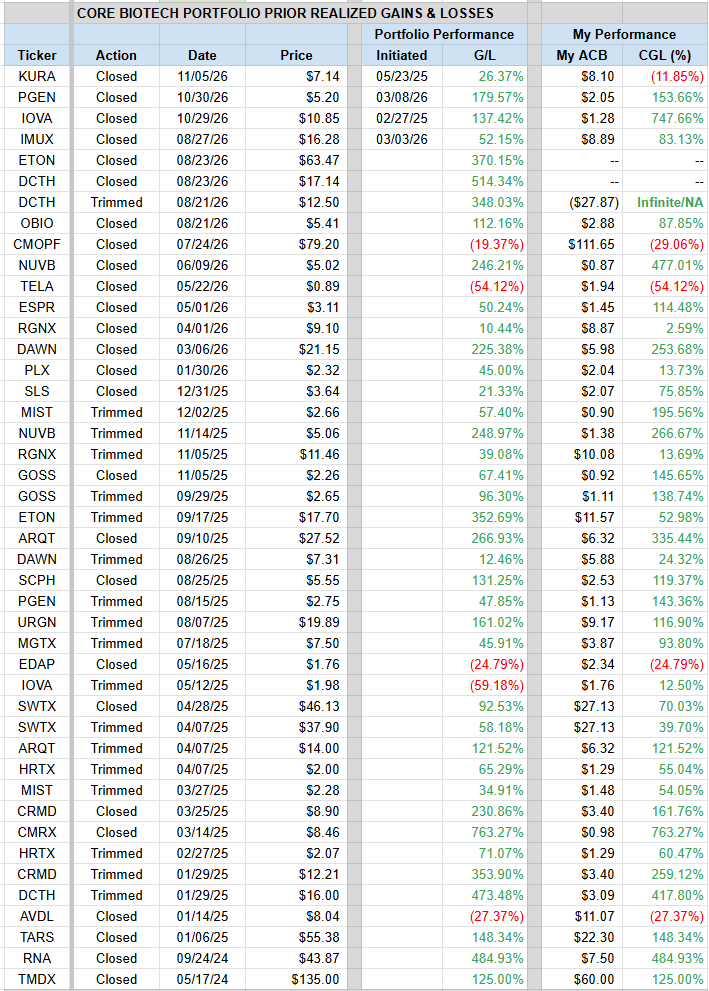
Please note that the BiQ ACB (adjusted cost basis) includes shares and all open options positions, which are accounted for using a "worst case scenario" assumption, plus realized trading profits (and losses) around my core position.
Not a BiQ Premium member, or have a friend who may be interested? Try BiQ Premium for $50 per month, or $375 (25% off) for the first year.
Biotech iQ is 100% subscriber supported. If you find this information helpful, please spread the word. You can also follow me on X @ Biotech iQ (_Biotech_iQ).
Biotech iQ is not an investment professional, and nothing on this page or this website should be considered investment advice. Please consult with a licensed investment professional as necessary. Past performance is not indicative of future results.
Section 3: Paid Member Section & Weekly Discussion Topics
The Paid Member Section includes additional discussion of key topics, portfolio updates, and my trading activity over the past week.