BiQ: Weekly Recap for 11/01/26
Most of the information contained in this Weekly Recap has been previously discussed in the BiQ Chat forum. I encourage members who haven't joined BiQ Chat yet to join our Discord group. Instructions can be found here.
This week's discussion topics for Premium members can be found in the Premium Member section at the bottom of this article:
- Microsoft, Google, and Amazon Reported Earnings Last Week. Why Did Microsoft Avoid the Slide?
Section 1: Selected Weekly Highlights
Biotech
- At ESMO, Iovance (IOVA) and Memorial Sloan Kettering investigators presented pilot data for one-time lifileucel in refractory undifferentiated pleomorphic sarcoma (UPS) and dedifferentiated liposarcoma (DDLPS). The result: a 50% confirmed ORR among the first eight evaluable patients. All four partial responses, two in each subtype, were still ongoing at 6+ to 46+ weeks. Across all 10 infused patients, ORR was 40% and disease control was 80%. Those numbers compare with sub-5% response rates and about 9–10 months of median OS for current second-line options. Safety was in line with the standard TIL regimen, with no treatment-related deaths.
The sample is tiny, and the confidence interval on that 50% runs from roughly 16% to 84%. Still, given the poor outcomes seen with SoC regimens, there’s room for regression in a larger study. SARATOGA, the registrational Phase 2, uses IRC-assessed ORR as its primary endpoint, and FDA already granted Fast Track for both subtypes. Commercially, these patients are concentrated at academic centers that overlap Iovance’s existing treatment-center network, so any approval would add volume with little added infrastructure, which translates into operating leverage. Soft tissue sarcoma runs about 3.5 new US cases per 100,000 people a year, and UPS and DDLPS are only part of that. The limited TAM makes this a solid add-on indication, but not material for the thesis.
The disappointing NSCLC update largely overshadowed the positive sarcoma data. IOVA closed Friday at $8.48, down from $14.81 on October 28, after lung data showed just an 11.4% ORR in KRAS-mutant patients. Sarcoma won’t offset a significantly narrower lung opportunity, but it adds another registrational shot on goal outside melanoma. The next catalyst is Q3 results on November 5. - Beam Therapeutics (BEAM) presented the first clinical data for BEAM-301, its LNP-delivered base editor that corrects the R83C mutation in GSDIa, at ESGCT. As of the August 17 cutoff, six patients had been dosed, three each at 20 mg and 40 mg, with median follow-up of 7.6 months. The 40 mg cohort carried the story. Median time to fasting hypoglycemia rose from 2.5 hours at baseline to 15 hours by Day 36, and two of three patients hit the protocol’s 15-hour fasting cap and no longer needed cornstarch at all. The third 40 mg patient showed no fasting improvement at the first check, which Beam partly attributed to elevated BMI and carrying only one copy of R83C. Safety bears watching: four of six patients had related serious adverse events, including three grade 3 infusion reactions. Beam has since modified premedication and infusion rates. Liver enzyme elevations were mild and resolved on their own.
This is solid proof of concept for in vivo base editing directly correcting a disease mutation. It also gives Beam’s liver franchise a second clinical anchor alongside BEAM-302. Beam is moving into a 60 mg cohort and plans to engage FDA on an approval path. The bar has moved, though: Ultragenyx’s AAV gene therapy Genglycos won accelerated approval in August for GSDIa patients aged eight and older. BEAM-301’s potential edge is that a genomic correction shouldn’t dilute as the liver grows, which could matter for younger patients. However, it only addresses R83C patients within a disease of roughly 6,000 people in commercially accessible markets. One analyst puts peak sales at $475 million, meaningful but not thesis-defining for BEAM on its own.
The stock closed Friday at $27.23, up 13% on the week, helped partly by new FDA draft guidance on genome editing. Q3 results are due Tuesday, November 3. - FDA’s CBER issued draft guidance on October 27 that sets out how a single BLA can cover many patient-specific versions of a genome editing therapy. The core concept is the “individualized feature space” (IFS). Sponsors define upfront which components can vary from patient to patient, typically the guide RNA. Everything else stays fixed, including the formulation and the delivery vehicle. Clinical data must back those boundaries, tied to in vitro thresholds for on-target editing and off-target safety. After approval, a new variant inside the IFS counts as a manufacturing change rather than a new product, so it can be added by supplement with lab data without a new trial. The limits matter. Every variant in a BLA must share the same mechanism and editing outcome, so, for example, a prime editor can’t share a BLA with a base editor. A variant that causes a clinically distinct disease counts as a new indication needing clinical evidence. The guidance also doesn’t cover what clinical data the initial approval requires. Comments are due November 27.
The biggest winners are modular in vivo platforms where one editor and LNP can be retargeted just by swapping the guide. Prime Medicine (PRME) has the most leverage. Prime editing covers the broadest range of mutation types with a single editor, and per Jefferies, Prime already has FDA alignment to add Wilson disease mutations under its existing IND using most of the H1069Q data package. TD Cowen also singled out Prime as especially relevant, and PRME rose 29% on the week. Beam is a close second; the guidance’s own worked example is essentially an adenine base editor product. Jefferies sees the framework accelerating Beam’s PKU program, which uses three mutation-specific base editors, into the clinic around year-end. Base editing addresses fewer mutation types than prime editing, but Beam’s in-house manufacturing fits the guidance’s heavy CMC emphasis. Toolmakers and suppliers serving small-batch guide RNA and LNP manufacturing should also benefit as N-of-1 programs scale.
Intellia and CRISPR Therapeutics rallied in sympathy, but their lead in vivo programs use one guide for every patient to knock out a target gene. Those programs aren’t individualized, so in my opinion, the direct benefit is minimal. AAV gene replacement players like Ultragenyx and Sarepta are also outside the scope, since one gene-addition product already covers all variants. For now, this is only draft guidance; however, the longer-term implication is that ultra-rare mutations could finally become commercially viable for editors. This has been a component of my PRME thesis for some time, so I'm happy to see the thesis start to play out.
Space, Aerospace, & Defense
- AST SpaceMobile (ASTS) received S-band spectrum authorization from Brazil’s regulator, Anatel: 15+15 MHz, or 30 MHz total. It also won approval for secondary use of up to 10+10 MHz in the 700 MHz band through agreements with four regional operators, usable only within those operators’ licensed areas. AST also plans to build four gateways in Brazil to connect its BlueBird satellites to operator networks. The company points to more than 200 million handset lines in Brazil and large coverage gaps. By its estimate, roughly half the federal and state highway network and two-thirds of agricultural land lack 4G or 5G. The new agreements add to a roster of more than 60 operator partners covering about 3 billion subscribers.
The S-band authorization is the most important piece. AST’s model generally depends on partners’ low-band spectrum, which limits capacity. Thirty megahertz of S-band that AST controls directly adds bandwidth for data and video and gives it more leverage with operators. It also fits a broader push to secure more spectrum, alongside the FCC’s recent proposal to expand the spectrum available for “supplemental coverage from space”. The release gives no revenue figures or launch date, though. Service will expand only as satellite capacity and ground infrastructure come online, and AST is targeting roughly 45 satellites by early 2027. The gateways also add to capital spending.
While I see this as a significant long-term positive, it doesn’t change the near-term challenges, which center on launch cadence and competition from SpaceX. ASTS closed Friday at $40.97, down about 44% from where it started the year, after hitting a one-year low amid SpaceX’s Starlink spectrum expansion, a Piper Sandler downgrade, a securities lawsuit, and ongoing earnings misses. The next checkpoint is the November 9 earnings report, where I'll focus on launch timing and the $150 million to $200 million 2026 revenue forecast.
Information Technology
- At Oracle’s AI World event on October 27, Cerebras (CBRS) and Oracle (ORCL) announced plans to offer Cerebras inference on Oracle Cloud Infrastructure starting in calendar 2027. The release is thin on specifics. It gives no dollar value, capacity, regions, or models, and doesn’t say whether Cerebras systems will sit in Oracle data centers or be reached through Cerebras’ own cloud. Oracle used the same event to add Google TPUs, SambaNova’s SN50 chip and a larger Nvidia Vera Rubin deal, pitching its inference strategy around customer choice. CBRS rose about 10% that day, then gave it all back the next.
The value here is diversification and validation rather than near-term revenue. Oracle becomes Cerebras’ second hyperscale channel after AWS, which plans to offer Cerebras-powered inference on Bedrock in Q1 2027. That matters because a significant share of Cerebras’ $25.4 billion backlog comes from OpenAI, and concentration has been a central investor concern. Still, this is one non-exclusive option on a crowded menu, and until Oracle commits to actual capacity, it’s hard to model.
OpenAI remains the anchor partnership. Its December 2025 agreement covers 750 MW of inference capacity over three to four years, with an option for another 1.25 GW by 2030. OpenAI also funded a roughly $1 billion secured loan, and Cerebras was a launch partner for GPT-5.6 Sol. AMD is pairing its GPUs with Cerebras systems to split, or disaggregate, inference workloads, targeting up to 5x higher throughput, with production expected in Q4 2026. Enterprise and AI-native customers include Cognition, Lovable, Block, Figma, AlphaSense, GSK and CrowdStrike. On the build side, Flex, Sanmina and Rocket EMS manufacture its systems.
The pullback has been steep. CBRS priced its May IPO at $185, closed its first day at $311.07 and peaked at $386.34. It finished Friday at $109.18, about 41% below the IPO price and 72% off the high. Several pressures stacked up:
* The October AI-infrastructure rout pushed the Philadelphia Semiconductor Index into correction, and Nvidia fell more than 10% in three days.
* Insiders sold about $395 million of stock over three months, including the COO’s roughly $81 million sale, as share lockups expired. Up to about 171 million more shares can be sold starting November 10.
* An unconfirmed SemiAnalysis report said OpenAI’s GPT-6.1 Sol Ultrafast tier runs on Nvidia GPUs rather than Cerebras.
* On October 28, Culper Research alleged the wafers degrade after about two years. It also flagged that Cerebras lengthened the assumed useful life of its systems from 1.5–3 years to 3–5 years between IPO filings without explanation. The stock fell 11%, and law firms followed with investigation notices.
As for the Q2 margin drop, it is mostly an accounting artifact, with one real operational drag. GAAP gross margin fell to 14% from 31% a year earlier, and gross profit fell 20% even as revenue rose 74%. The biggest drivers are non-cash. Warrants Cerebras granted to OpenAI are amortized against revenue as OpenAI buys compute, which cut $44.3 million from Q2 revenue, with roughly $1.1 billion still to be amortized through 2031. The shift toward cloud, which grew from 32% to 70% of revenue, also changes the margin profile. On the company’s “core” basis, which adds back the warrant amortization, gross margin was 41%, down from 46.5% in Q1. The operational hit came from a rent-back arrangement. With demand outrunning its own data center buildout, Cerebras temporarily rented back systems it had previously sold to cloud customers, which cost about five points of core gross margin. Management guided Q3 core gross margin to 38–40%, which it called the trough, and expects the drag to ease as owned capacity comes online.
IMO, capacity, not demand, is the gating factor for growth, though management now points to data center space more than manufacturing as the tighter constraint. Manufacturing is ramping quickly. Capacity is already 4x its first-half 2025 level and expected to grow more than 10x in 2026, including about 7x more CS-3 output from Flex’s Milpitas expansion. Contracted facilities can support another 3–4x in 2027. Cerebras has secured its TSMC 5nm wafers and avoids HBM, CoWoS packaging, and 3nm capacity, which constrain GPU suppliers. CEO Andrew Feldman calls data center space the industry’s real bottleneck, and he said the 600+ MW Cerebras has secured through 2027 “isn’t nearly enough.” That’s why hyperscaler channels matter. AWS will run Cerebras inference in Amazon’s own data centers, and an Oracle deployment inside OCI would offload more of the buildout. Management expects to more than triple core revenue in 2027 from the $880–890 million guided for 2026, and hitting that depends on capacity arriving on schedule. Culper’s lifespan claim matters here too: if systems wear out faster, more capacity goes to replacement instead of growth. For now, however, those claims are unresolved. Q3 results on November 12 are the next test, and hopefully management uses the opportunity to address the lifespan allegations.
Section 2: Core Biotech Portfolio Performance
The table below shows current and past performance for the Core Biotech portfolio. To view the full unredacted portfolio performance across our entire portfolio, including biotech and non-biotech names, members can click here for the complete spreadsheet.
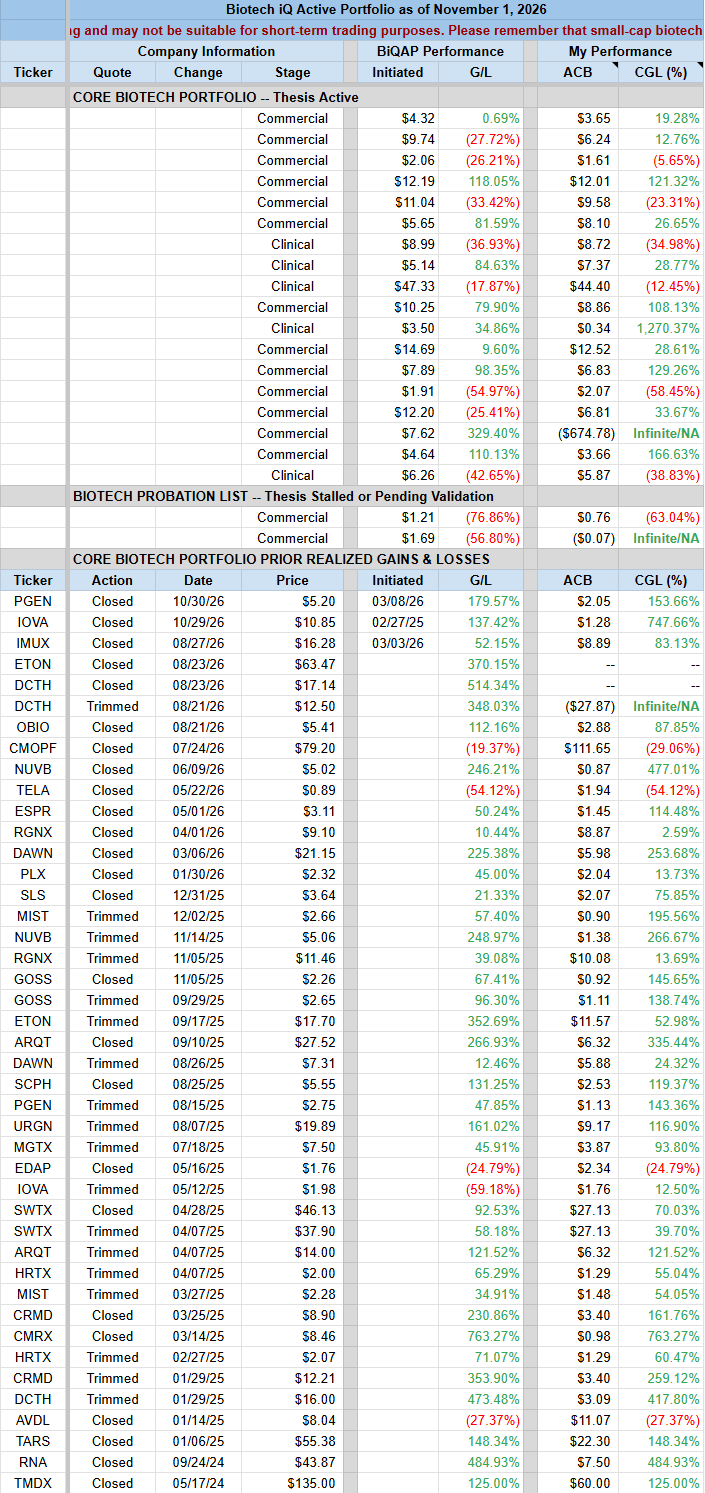
Please note that the BiQ ACB (adjusted cost basis) includes shares and all open options positions, which are accounted for using a "worst case scenario" assumption, plus realized trading profits (and losses) around my core position.
Not a BiQ Premium member, or have a friend who may be interested? Try BiQ Premium for $50 per month, or $375 (25% off) for the first year.
Biotech iQ is 100% subscriber supported. If you find this information helpful, please spread the word. You can also follow me on X @ Biotech iQ (_Biotech_iQ).
Biotech iQ is not an investment professional, and nothing on this page or this website should be considered investment advice. Please consult with a licensed investment professional as necessary. Past performance is not indicative of future results.
Section 3: Paid Member Section & Weekly Discussion Topics
The Paid Member Section includes additional discussion of key topics, portfolio updates, and my trading activity over the past week.