BiQ: Weekly Recap for 10/25/26
Most of the information contained in this Weekly Recap has been previously discussed in the BiQ Chat forum. I encourage members who haven't joined BiQ Chat yet to join our Discord group. Instructions can be found here.
This week's discussion topics for Premium members, which can be found in the Premium Member section at the bottom of this article, include the following:
- Parkinson's Heats Up: Taking a Look at MeiraGTX's AAV-GAD vs. Aspen Therapeutics' Sasineprocel.
- Russia Has Launched a Shadow War on Europe. What Does it Mean for European Rearmament?
Section 1: Selected Weekly Highlights
In this section, I cover selected weekly highlights for the various sectors we track at Biotech iQ. Each sector begins with a high-level summary of why I am interested in the sector, followed by selected sector updates.
BiQAP & Biotech
Biotech is a highly volatile sector that requires very careful consideration of both business and scientific rationale for successful investing. Although the sector faces several challenges, including valuation concerns, regulatory instability, AI disruption, and the growth of the Chinese biotech industry, I believe biotech remains a highly innovative and potentially profitable sector to invest in. I have been a biotech investor for over 20 years, and it remains a core focus of this service.
- Iovance (IOVA) presented final Cohort 1A data for lifileucel plus pembrolizumab at ESMO: 62.5% ORR, 29.2% CR rate, median PFS of 19.8 months, and median OS not reached at more than four years of follow-up. The cohort still has the same 15 responders and 7 complete responses, with the denominator moving from 23 to 24. The new pieces are the OS data, which is impressive for a one-time therapy, and PFS reaching a median, though its lower confidence bound is just 3.6 months. As for the caveats, this was 24 patients, investigator-assessed, and only patients who received in-spec product were counted. TILVANCE-301, by contrast, randomizes before tumor resection and uses blinded central review.
For the thesis, I see the update as slightly positive. The data keep the frontline option credible but (IMO) don’t really change the PoS for TILVANCE-301. Shares closed Friday at $14.09, down 0.4%, on about half normal volume. For now, the IOVA story still rests on the Amtagvi ramp. Q2 revenue was $99.3M, and the company raised FY26 guidance to $410–420M, so Q3 results on November 5 are the next real test.
https://ir.iovance.com/news-releases/news-release-details/iovance-presents-new-data-esmo-2026-demonstrating-deep-durable - In other news that could potentially relate to IOVA, Merck and Moderna’s full INTerpath-001 data came out a few days early after the abstract leaked Thursday, and ESMO lifted the embargo on the full dataset that evening. In resected stage IIB–IV melanoma, adding intismeran to Keytruda reduced the risk of recurrence or death by 42% (HR 0.58) and the risk of distant metastasis or death by 38% (HR 0.62), with two-year RFS of 82.2% vs. 70.0%. The benefit was back-loaded: the curves were indistinguishable in the first six months (HR 0.99), but after the immunization regimen, the HR dropped to 0.42. Grade 3–5 treatment-related AEs ran 14.2% vs. 13.4%, OS is immature but trending favorably, and the companies are engaging with regulators. It was a clear win.
With regard to IOVA/Amtagvi, however, I think the near-term read-through is limited. Intismeran is an adjuvant therapy, while Amtagvi treats metastatic disease after PD-1 failure. Fewer recurrences could slowly shrink Amtagvi’s patient pool, but that’s years away. Long term, intismeran is targeting the same 1L setting as TILVANCE-301, and Merck is testing intismeran plus Keytruda against Keytruda alone in first-line advanced melanoma in the Phase 2 INTerpath-012. Frontline is shaping up as the true long-term battleground between the two approaches, but there's still a long road ahead. - Progressive MS got two CD19 CAR-T readouts on the last day of MS Toronto, and they come at the problem from opposite directions. Kyverna’s (KYTX) miv-cel is autologous, made from each patient’s own T cells. TGTX’s azer-cel is allogeneic: it is made from donor-derived T cells edited with Precision BioSciences’ ARCUS genome editing technology and is designed to minimize graft-versus-host disease, so it can be given off the shelf. TGTX licensed global rights to azer-cel for autoimmune and other non-cancer indications from Precision in January 2024.
Kyverna’s update came from the Stanford investigator-initiated study. Six non-relapsing SPMS/PPMS patients received a single dose of 33 million or 100 million CAR T cells after bendamustine lymphodepletion. Five were evaluable, and all five had stable-to-improved EDSS at last follow-up. Four of the five kept their benefit through one year without chronic immunotherapy, and the first patient is now past two years. Peripheral B cells were completely depleted, with naïve B cells returning from month 3. There was no high-grade CRS and no ICANS.
TGTX’s company-sponsored Phase 1 is larger and enrolled a sicker population. It treated 26 patients across six dose levels from 30 million to 500 million cells, also after bendamustine. Every patient had progressed independent of relapse activity in the prior 12 months despite high-efficacy therapy; all had prior anti-CD20 exposure, and median baseline EDSS was 6.0. Median follow-up was only 4.9 months. EDSS was stable or improved in 16 of 18 evaluable patients at Day 90 and 7 of 8 at Day 180. Three patients improved by at least 2 points, including one by 4. No patient evaluable by MRI showed gadolinium-enhancing or new/enlarging T2 lesions. On biology, peripheral B cells fell below 10 cells/µL in 25 of 26 patients, and CSF CD19+ B-cell events dropped by a median 52.3% at Day 10. B cells returned as early as Day 42, mostly as transitional and naïve cells. Safety was clean: no dose-limiting toxicities, no Grade ≥3 CRS, no Grade ≥2 ICANS, no GvHD, no IEC-HS, and no Grade ≥3 infections.
The usual caveat about comparing across trials applies here even more than usual. TGTX's strengths are its larger and tougher, anti-CD20-refractory population. But 90 days is very short in a disease that moves slowly; most progressive patients look “stable” over three months whether or not a drug works. Multi-point EDSS swings in an open-label study at EDSS ~6 need confirmation before anyone leans on them. Kyverna has what TG can’t show yet: durability past one and two years, though in only five patients. The biology also hints at the platform trade-off. B cells returned around month 3 with miv-cel versus as early as Day 42 with azer-cel, and TGTX’s CSF B-cell reduction was partial. That pattern is what you’d expect if the host clears donor cells faster. Since both programs used bendamustine, lymphodepletion doesn’t explain the difference. Whether a shorter, shallower hit is enough for a durable immune reset is the central question for allogeneic CAR-T in autoimmunity, and TGTX’s 6- to 12-month data should start answering it. Historically, durability has typically been the Achilles heel of allogeneic CAR-T therapies.
The commercial logic of each approach runs the other way. Autologous CAR-T has shown deep, durable depletion, but it requires apheresis, weeks of manufacturing, and treatment at specialized centers. Kyverna’s answer is KYV-102, its whole-blood rapid manufacturing process. Those logistics are manageable in an ultra-rare disease like SPS, which affects roughly one in a million people, but they get much harder at progressive-MS scale. That is where an off-the-shelf product, possibly cheaper per dose and potentially redosable, becomes strategically attractive, if the efficacy and durability hold up.
In early 2027, we should also be receiving initial data from Autolus's (AUTL) obe-cel in the same indication.
For the stocks, neither readout moved the needle much. KYTX closed down 5.9% at $5.39 on Oct. 23, near its 52-week low, for a market cap of about $333 million. TGTX finished up 1.9% at $54.17, an ~$8.3 billion market cap. For TG, azer-cel is upside layered on top of Briumvi. The company raised its 2026 U.S. Briumvi net revenue target to about $890–905 million and had $612 million in cash at the end of Q2. It can fund a randomized progressive-MS trial and already calls on the same neurologists, and azer-cel is a natural next step for patients who progress on anti-CD20 therapy. For Kyverna, a well-funded MS incumbent entering progressive MS with a 26-patient dataset raises the bar. It also strengthens the case that a controlled miv-cel trial in progressive MS will need a partner or fresh capital, which puts particular focus on the early 2027 strategy update. Near term, KYTX still trades on SPS, where the rolling BLA is on track for completion in Q4 2026, and the company plans to seek priority review. Bottom line: Kyverna has the longer data, and TG has the bigger data and the balance sheet. Neither has yet shown that CAR-T changes the course of progressive MS.
https://kyvernatx.gcs-web.com/news-releases/news-release-details/kyverna-therapeutics-highlights-promising-updated-clinical-data
https://ir.tgtherapeutics.com/news-releases/news-release-details/tg-therapeutics-announces-phase-1-data-evaluating-azer-cel - Scynexis (SCYX) completed its Phase 1 SAD/MAD study of IV SCY-247, its second-generation fungerp, and the data were clean. Across 56 healthy volunteers (single doses up to 300 mg, seven days of once-daily dosing up to 200 mg), the drug was generally well tolerated. The most common side effects were mild-to-moderate infusion-site redness and pain, with no drug-related SAEs. Once-daily IV doses of 50 mg or more hit the efficacy exposure target from mouse models, versus 100 mg or more for the oral version, which sets up the IV-to-oral step-down the company is pitching. Phase 2 in both formulations is now expected in 2027, pending FDA agreement, with the recent BARDA contract (up to ~$214M if all options are exercised) covering much of the cost. Infusion-site tolerability is the detail to watch when full data come out. Shares barely moved and still trade at roughly half the company’s last reported cash.
https://ir.scynexis.com/news/detail/375/scynexis-completes-phase-1-study-of-intravenous-scy-247-a-novel-triterpenoid-antifungal-in-development-for-treatment-and-prevention-of-invasive-fungal-diseases
Space, Aerospace, & Defense
The world is in the early stages of a global shift from an environment of relative (relative being the key operative word) peace and stability to one of increasing military confrontation and threats. The nature of warfare is changing rapidly, with cheap, autonomous drones reshaping asymmetric warfare. The US is in the midst of a major rearmament and modernization cycle while also needing to rebuild its depleted strategic munitions stockpiles. Across the Atlantic, the EU now faces significant threats on both its Eastern and Western flanks as the US withdraws from its NATO security commitments and takes a more adversarial posture, which will force the EU into a multi-year rearmament cycle focused on strengthening sovereign supply chains and reducing reliance on the US as a strategic defense partner.
- SpaceX had a busy week. Q3 was a blowout on the top line: revenue reached $14.6 billion, up 161% from $5.6 billion a year earlier, beating estimates of $12.7–$13.0 billion, and net income was $4.4 billion. Super Intelligence revenue rose 830% to $7.56 billion, while Connectivity grew 69% to $5.25 billion, and consumer subscribers rose by 1.6 million to 13.6 million. Management also forecast first-quarter 2027 revenue between $33 billion and $37 billion, well above the $22.2 billion LSEG consensus, and the stock jumped 10% Wednesday, helped along by Musk saying Tesla and SpaceX have formed special committees to discuss a merger.
Then on Thursday, Bloomberg reported that SpaceX is looking to lease space on 80,000 cell sites across the U.S., and is in talks with Crown Castle and American Tower. That’s about half of all purpose-built cell towers in the country, and roughly in line with the Big Three’s footprints (BNP estimates AT&T and Verizon each have about 65,000–75,000 towers, while T-Mobile has disclosed about 85,000). If the report is accurate, this reads like a genuine fourth-carrier push, not just a satellite add-on. Tower stocks jumped, and the carriers sold off on the news.
My concern is the funding. Q3 capex was $19.59 billion, which is more than the quarter’s total revenue, and the CFO said Q4 capex would be $35 billion to $40 billion. Year-to-date capex already exceeds operating cash flow, and SpaceX secured $40 billion in debt to buy Nvidia chips. That’s all before the wireless build, which TD Cowen estimates would cost more than $80 billion, and the $8 billion Grain spectrum deal still needs FCC approval. The MNO entry also has a timing mismatch that concerns me: spectrum, radios, and tower leases get paid for upfront, while meaningful revenue is likely years out. For context, Dish took four years to reach 20,000 sites, and SpaceX hasn’t given a date for when new services will become available. It was an impressive quarter, but SpaceX is trying to fund an AI buildout and a nationwide carrier at the same time. And none of this includes the company's target of adding 10GW of compute in 2027. At an estimated $40M/MW, that's an additional $400B in capex.
It's not always easy to separate reality from hyperbole when it comes to Musk companies, but if SPCX actually pursues these initiatives, it will need to raise a tremendous amount of capital heading into a tightening lending environment. - In August, three explosive-laden drones were flown at a Ukraine-bound cargo plane at Germany’s Leipzig-Halle Airport. One hit the aircraft and failed to detonate. U.S. intelligence now sees it as an opening shot in a sabotage campaign Putin personally ordered against NATO. It’s part of a broader pattern: drones over Poland, a strike on an apartment building in Romania, arson at European drone makers, and this month’s attacks on merchant ships in the Black Sea. Washington’s response has mostly been to hand Europe’s defense back to Europe, drawdown troops stationed in Europe, and sign a $7B energy purchase from Russia, in addition to canceling Russian sanctions. Europe is answering with budgets, starting with Germany’s plan to raise defense spending by about a third next year. The members’ section of the newsletter covers why this looks like the start of a multi-year European buildout, and what could slow it down.
https://www.wsj.com/world/europe/airfield-attack-marked-opening-shot-in-putins-sabotage-campaign-against-europe-115dedd4
Energy
Every economy runs on energy, and for decades, energy has mostly been relatively cheap and plentiful across developed nations. However, the recent rapid growth of AI compute and ongoing electrification is driving a multi-year transformation and growth cycle in energy and energy tech.
- Bloom Energy (BE) delivered its third beat-and-raise of 2026. Q3 revenue rose 138% to $1.24B, about 16% above consensus, and non-GAAP EPS of $0.94 beat the ~$0.69 estimate. Non-GAAP gross margin reached 34.5% with no help from a tariff refund this time. Operating margin hit 23.1%, up from 8.9% a year ago. Full-year guidance is now $4.4–4.6B of revenue (from $3.9–4.2B in July and $3.1–3.3B in February) and non-GAAP EPS of $3.10–3.40, against a $2.71 Street number. Subtracting nine-month results, that implies Q4 revenue of $1.35–1.55B against ~$1.2B consensus.
The stock moved the other way. Shares fell 8.7% on Thursday ahead of the release, then dropped another 11.2% Friday to close at $193.30. That is about 19% over two sessions, leaving the stock more than 40% below its June high and at ~59x the midpoint of 2026 EPS guidance.
Operating cash flow was −$27M and free cash flow −$181M, on roughly $250M of net income.
The bull reading: this is working capital, not a broken model. Cash earnings before working capital were about $330M. A ~$356M net working-capital build turned operating cash flow negative, and $153M of capex for the Fremont and Newark lines did the rest. Without the build, Q3 FCF would have been about +$175M, and year-to-date FCF is still +$42M. Bloom is paying up front ($178M of vendor advances, $170M of inventory) to support a revenue base that is more than doubling, while customer billing follows contract milestones. Customers are prepaying too: deposits climbed to $661M from $78M at year-end. The balance sheet can carry the build. Cash of $2.49B roughly matches $2.53B of debt, nearly all of it 0% converts due 2030, and $510M of the revolver is undrawn.
The bear reading: the issue is what kind of working capital this is. The largest use was $430M of contract assets, which is revenue recognized on delivery but not yet invoiced. In all, 37.5% of Q3 revenue had not been billed. Receivables plus contract assets now equal ~111 days of revenue, up from ~73 at year-end. A related party tied to Bloom’s Brookfield fund JVs holds 31% of receivables. CFO Simon Edwards said contract assets will turn, but the balance may keep growing, and he gave no Q4 cash outlook. Bloom also has $5.8B of supplier commitments, $2.6B of it in 2027, so the cash cycle matters more than usual.
Ultimately, I lean more toward the bull reading; however, I could be wrong, and the bearish angle should be considered as well. Q4 operating cash flow will decide which reading is right. If contract assets convert to billings and collections, the self-funding story holds. Another negative quarter would make the timing explanation much harder to defend.
Oracle’s Project Jupiter went unmentioned on the call. In September, Oracle sent a force majeure notice preserving its right to defer rent if the New Mexico campus misses its 2028 start because its power supply isn’t ready. The gas pipeline that feeds Bloom’s fuel cells has slipped to February 2027, and the state’s decision on the microgrid’s air-quality permit is due by Nov. 23. Sridhar has said Bloom’s units are fungible and can be redirected if a project slips, so it will be interesting to see how the next couple of quarters play out in the real world.
Industrials
New technological advances across energy, technology, aerospace, and materials, combined with an increased need to secure sovereign supply chains, will provide multi-year growth opportunities for key strategic industrial companies.
Information Technology
We are still in the early stages of the AI adoption cycle, which I think will drive multi-year growth across the sector for strategically positioned technology companies that can navigate the headwinds resulting from a tightening financing environment.
- Meta’s Q3 top line was hard to fault. Revenue rose 26% to $64.6 billion, clearing the top of its own guidance range again. Most of the growth came from pricing: average price per ad rose 14%, while impressions grew 10%. GAAP EPS of $3.83 includes a $9.89 billion charge tied to the August teen mental health settlement with 52 state attorneys general. Excluding it, EPS was $7.40, roughly flat with last year’s $7.25. Q4 revenue guidance of $73–76 billion landed roughly in line to slightly ahead of the Street.
The debate is about cash. Capex of $34.9 billion topped $32.8 billion of operating cash flow, pushing free cash flow to –$2.1 billion. On a capex-vs-operating-cash basis, that hasn’t happened since 2012. Meta raised the floor of its 2026 capex range to $135–145 billion, implying a record Q4. It offered no 2027 number, only a commitment to keep investing aggressively, with guidance deferred to the Q4 call. It also announced a non-voting Class C share, distributed one-for-one to existing holders starting January 19, 2027. Effectively, that’s a 2-for-1 split, but Meta says the new class can be used to raise capital and fund deals without diluting Zuckerberg’s control. Much of the Street took that as a setup for an equity raise. I agree.
On AI, Muse is off to a fast start. More than 10 million people in the US and Canada set it up in about six weeks, roughly a quarter use it daily, and shopping is the leading use case. For now, though, only subscriptions are monetized. Management also warned that serving costs will rise as usage grows, even as it targets a 10x-plus gain in compute efficiency.
Shares briefly rose about 4% after hours, then fell 7% Thursday to $648.85 and another 1% Friday to $642.62. Meta’s credit default swap spreads hit record highs (as they have across the industry), and the broader AI trade sold off alongside it. Analysts mostly raised targets, with the average near $846. More cautious voices point to a possible equity raise and 2027 capex estimates approaching $250 billion.
Precious Metals
I believe that rising global inflation and debt levels, together with growing global trepidation over the US as a reliable strategic and economic partner, will drive a multi-year growth cycle for precious metals.
Section 2: BiQAP Current & Past Performance
The tables below show current and past performance for the BiQAP portfolio (our core biotech holdings). To view full portfolio performance across our entire portfolio of biotech and non-biotech names, including the related tickers, members can click here for the complete spreadsheet.
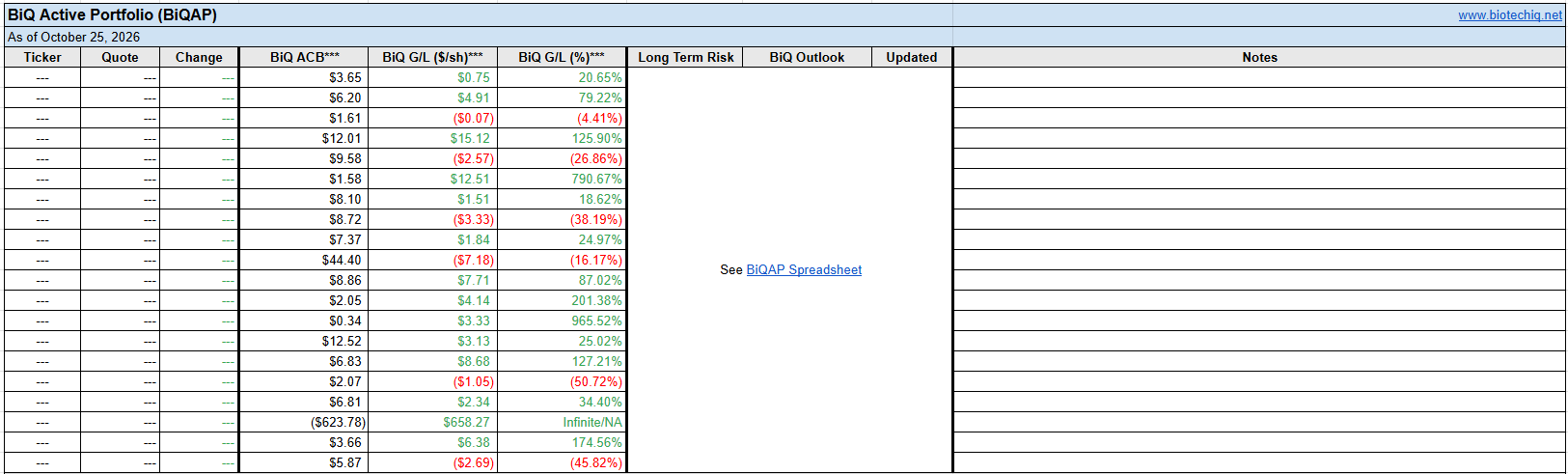
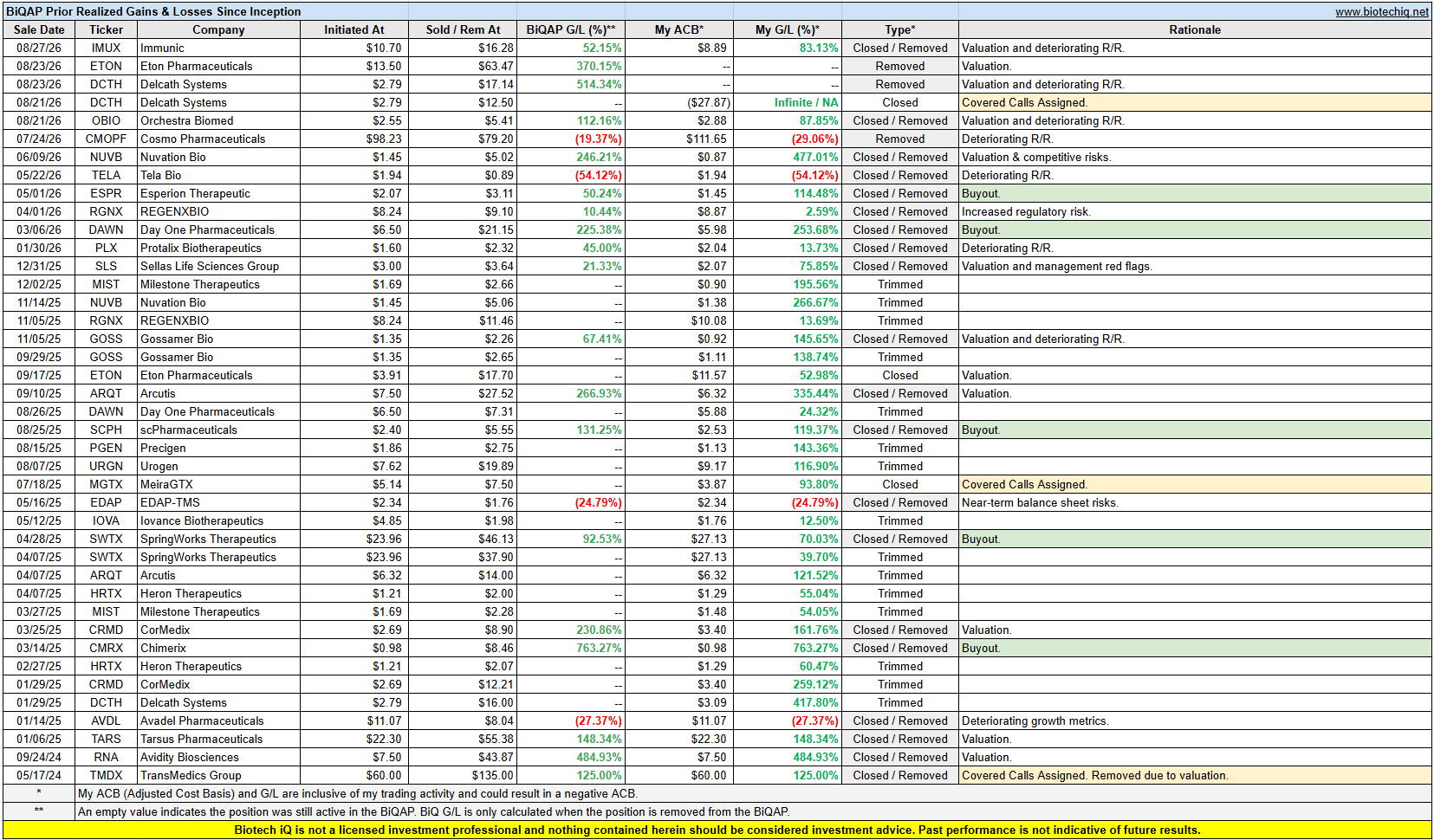
Please note that the BiQ ACB (adjusted cost basis) includes shares and all open options positions, which are accounted for using a "worst case scenario" assumption, plus realized trading profits (and losses) around my core position.
Not a BiQ Premium member, or have a friend who may be interested? Try BiQ Premium for $50 per month, or $375 (25% off) for the first year.
Biotech iQ is 100% subscriber supported. If you find this information helpful, please spread the word. You can also follow me on X @ Biotech iQ (_Biotech_iQ).
Biotech iQ is not an investment professional, and nothing on this page or this website should be considered investment advice. Please consult with a licensed investment professional as necessary. Past performance is not indicative of future results.
Section 3: Paid Member Section & Weekly Discussion Topics
The Paid Member Section includes additional discussion of key topics, portfolio updates, and my trading activity over the past week.