BiQ: Weekly Recap for 10/17/2026
A lot happened last week, and I was out of town for the weekend, so I apologize for the delay in publishing the Weekly Recap.
Most of the information contained in this Weekly Recap has been previously discussed in the BiQ Chat forum. I encourage members who haven't joined BiQ Chat yet to join our Discord group. Instructions can be found here.
This week's discussion topics for Premium members, which can be found in the Premium Member section at the bottom of this article, include the following:
- Does the Celcuity selloff represent an opportunity?
- What does last week's AI selloff tell us?
Section 1: Selected Weekly Highlights
In this section, I cover selected weekly highlights for the various sectors we track at Biotech iQ. Each sector begins with a high-level summary of why I am interested in the sector, followed by selected sector updates.
Biotech
Biotech is a highly volatile sector that requires very careful consideration of both business and scientific rationale for successful investing. Although the sector faces several challenges, including valuation concerns, regulatory instability, AI disruption, and the growth of the Chinese biotech industry, I believe biotech remains a highly innovative and potentially profitable sector to invest in. I have been a biotech investor for over 20 years, and it remains a core focus of this service.
- On October 13, Agomab (AGMB) dosed the first patient in NOV-ERA, its global Phase 2b study of ontunisertib (AGMB-129) in symptomatic fibrostenosing Crohn’s disease (FSCD). The primary endpoint is endoscopic passability of the index stricture at Week 24. Secondary endpoints include passability at Week 52, time to an FSCD-related event such as surgery or balloon dilation, MRE stricture changes, SES-CD, and patient-reported outcomes.
This moves its lead asset into late-stage development in an indication with no approved therapy aimed specifically at the fibrotic component of the disease. For those who haven't been following this name, ontunisertib is a GI-restricted ALK5/TGF-β inhibitor with FDA Fast Track Designation. It is designed to undergo rapid first-pass liver metabolism, avoiding the systemic exposure that has hampered ALK5 inhibitors in the past. Management said the positive long-term safety data from the STENOVA Phase 2a open-label extension supported adding the 400 mg BID arm. That arm gives the study a wider dose range and a better chance of finding an effective dose.
The multi-endpoint design is also interesting – and a strategic choice. Management explicitly framed it as a way to choose registrational endpoints for a future Phase 3, which makes sense since the regulatory path in FSCD is still undefined.
https://ir.agomab.com/news-releases/news-release-details/agomab-announces-first-patient-dosed-global-nov-era-phase-2b - Last week, Evolus (EOLS) signed an option deal with an unnamed private company that’s developing a sustained-release scalp injectable for hair restoration built around a “well-characterized therapeutic.” Evolus pays only $1.5 million upfront, plus modest milestone-based payments, and helps fund an initial proof-of-concept study. Based on the study data, it can choose to buy the whole program outright. It’s a cheap, low-risk way into a big new category, and an in-office scalp procedure fits naturally with the injectors who already buy Jeuveau and Evolysse.
On the last earnings call, management mentioned plans to enter the hair restoration segment, so this wasn't wholly unexpected. The program stays in formulation work through 2027, and human trials only start after that. Consider this a long-dated option for Evolus to enter a differentiated new – and potentially large – market segment that fits in nicely with its existing product pipeline; however, I don't expect any revenue impact for the foreseeable future.
https://investors.evolus.com/press-releases-and-news/news-details/2026/Evolus-Expands-Innovation-Pipeline-with-Novel-Injectable-Hair-Restoration-Program/default.aspx - Iovance (IOVA) is presenting five abstracts at ESMO in Madrid (October 23–27), plus two oral presentations, which are likely the most important to watch. On Friday, October 23, it presents final Phase 2 results for lifileucel plus pembrolizumab in checkpoint-naive advanced melanoma. That data supports the ongoing TILVANCE-301 Phase 3, which could potentially move Amtagvi into the much larger frontline market. On Monday, October 26, we get the first congress look at lifileucel in two tough soft tissue sarcomas, UPS and dedifferentiated liposarcoma. Both of these sarcomas have dismal outcomes with current SoC treatments. Iovance says the early MSKCC results were strong enough to go straight into the registrational SARATOGA trial. A real-world poster also suggests lifileucel may roughly double four-year survival versus standard of care in PD-1-resistant melanoma.
https://ir.iovance.com/news-releases/news-release-details/iovance-highlights-til-cell-therapy-platform-across-solid-tumors - Kura (KURA) used EASD and an October 13 webcast to lay out the diabetes plan for KO-7246, a next-generation oral menin inhibitor. The drug now belongs to Caspian Therapeutics, a company Kura spun out in September with a $50 million round led by BVF, with Eli Lilly among the participants. Kura contributed the asset, keeps roughly half the equity, and provides services to Caspian, so it holds meaningful upside without paying the development bill. The data are all preclinical:
* In diabetic rodent models, KO-7246 expanded beta cells and improved glucose control, including on top of semaglutide.
* In a severe insulin-deficiency model, the benefit lasted a month after dosing stopped.
* In human islet tissue, it drove proliferation selectively in beta cells.
KO-7246 is still in IND-enabling work, and no Phase 1 start date was given, so for KURA this is long-dated optionality alongside the KOMZIFTI story. The nearer test of the idea could come from Biomea Fusion (BMEA), whose clinical-stage menin inhibitor icovamenib has two Phase 2 type 2 diabetes trials with topline 26-week data expected in Q4 2026. Those results will be an early read on whether menin inhibition works in diabetes.
https://ir.kuraoncology.com/news-releases/news-release-details/caspian-therapeutics-and-kura-oncology-outline-ko-7246 - On October 16, the CHMP upheld its June negative opinion on Omeros's (OMER) narsoplimab in TA-TMA following re-examination, closing the door on European approval, at least for now. The ad hoc expert group recommended an external review of individual patient-level data, but the CHMP never gave that group the patient-level data Omeros submitted in August, which was no doubt frustrating for Omeros management. The outcome ends any near-term plan to license EU commercial rights to a partner, removing a potential source of deal revenue. Even so, Europe was never central to the OMER thesis, which rests on the U.S. Yartemlea launch. Omeros also announced it would wind down its compassionate use program in Europe. For now, the focus is U.S. sales growth and label expansion, with studies in ARDS and pediatric TA-TMA prevention planned to start later this year.
https://investor.omeros.com/news/news-details/2026/Omeros-Corporation-Receives-CHMP-Negative-Opinion-Following-Re-Examination-of-European-Marketing-Authorization-Application-for-Narsoplimab-in-TA-TMA/default.aspx - Ultragenyx (RARE) agreed on October 14 to sell the rare pediatric disease PRV it earned with the FAYUVI (UX111) approval in MPS IIIA for $203 million. It is the company’s second voucher sale in a week, following the $210 million GENGLYCOS deal. The two sales total $413 million in headline proceeds, although 20% of the GENGLYCOS gross proceeds goes to the NIH under a prior agreement (hat tip to BiQ Member @coooler for sleuthing this information out of the 8-K). That is a large addition to the $436 million in cash Ultragenyx held at the end of Q2, when quarterly operating cash burn was $97 million. The voucher sales potentially reduce the near-term need for dilutive financing while the two gene therapy launches ramp. While this is a good start, I will be looking for management to provide an update on additional cost-cutting measures and cash runway guidance on the Q3 earnings call.
https://ir.ultragenyx.com/news-releases/news-release-details/ultragenyx-enters-agreement-sell-rare-pediatric-disease-0 - Telix signed a collaboration with Ekalia, a joint venture of IBA and Framatome, to set up U.S. production of the alpha emitter astatine-211. The first IBA alpha-beam cyclotron will go in at Telix’s RLS radiopharmacy site near Philadelphia, and the two parties can consider more sites as demand grows. At-211 has a half-life of only about seven hours, so access depends on producing it near where patients are treated. This deal gives Telix priority access for early-stage programs such as TLX102-Tx in glioblastoma and leptomeningeal disease, and it lets RLS sell capacity to outside academic and industry programs. No financial terms or installation timeline were disclosed, and the At-211 programs are still in early development. This is a long-tem, strategic addition to the vertical-integration story rather than a material near-term event; however, I think it further strengthens TLX's long-term strategic positioning in the radiopharmaceuticals space.
https://telixpharma.com/news-views/telix-and-ekalia-to-collaborate-on-astatine-211-production-in-the-u-s/ - The FDA accepted UroGen’s NDA for UGN-103 in recurrent LG-IR-NMIBC with a PDUFA date of June 14, 2027, indicating a standard review. UGN-103 pairs UroGen’s RTGel technology with a lyophilized mitomycin formulation licensed from Medac, designed to simplify manufacturing and reconstitution. The NDA rests on the single-arm UTOPIA trial in 99 patients. It showed a 77.8% complete response rate at three months, and among those responders, an estimated 94.5% remained event-free at six months, in line with ZUSDURI’s pivotal ENVISION results. UGN-103's real value is lifecycle management: if approved, UroGen expects its patent coverage to run to July 2044, extending the franchise’s exclusivity well beyond ZUSDURI. The key questions are how smoothly UroGen can move ZUSDURI patients onto UGN-103 after approval, and what the Medac supply and royalty terms mean for margins.
https://investors.urogen.com/news-releases/news-release-details/urogen-announces-fda-acceptance-new-drug-application-ugn-103 - Verastem (VSTM) had a busy week, with three major announcements on the same morning.
The headline was the first multi-tumor update for VS-7375 from TARGET-D 101. At the 900 mg go-forward dose, VS-7375 posted a 41% confirmed response rate in 22 patients with 2L+ pancreatic cancer, including two complete responses (one confirmed). The rate rose to 50% in the 2L subset (4 of 8) and was 36% in 3L/4L. Disease control was 86%, six-month landmark progression-free survival was 67%, and only 2% of patients discontinued due to side effects. Verastem also reported a 43% confirmed response rate in 2L+ lung cancer at 600 mg, and said it has FDA alignment on a three-arm first-line pancreatic Phase 3 that it plans to open by year-end. The patient numbers are small, and follow-up is short, but the timing worked in Verastem’s favor: FDA documents recently suggested the rival drug Rasonque has a more modest effect in G12D, the exact mutation VS-7375 targets.
Alongside the data, Verastem priced a $250 million offering at $8.00 per share. It also announced that CEO Dan Paterson will retire, with board member Michael Bailey taking over on January 1, 2027. A large raise and a CEO change would normally weigh on a stock, yet shares rose about 18% that day and traded above the offering price.
https://investor.verastem.com/news-releases/news-release-details/vs-7375-demonstrates-robust-anti-tumor-activity-across-advanced
https://investor.verastem.com/news-releases/news-release-details/verastem-oncology-announces-planned-chief-executive-officer
https://investor.verastem.com/news-releases/news-release-details/verastem-oncology-announces-pricing-250-million-offering-common
Space, Aerospace, & Defense
The world is in the early stages of a global shift from an environment of relative (relative being the key operative word) peace and stability to one of increasing military confrontation and threats. The nature of warfare is changing rapidly with the advent of cheap, autonomous drones changing the definition of asymmetric warfare. The US is in the midst of a major rearmament and modernization cycle and faces the challenge of rebuilding its depleted strategic munitions stockpiles. Across the Atlantic, the EU now faces significant threats on both its Eastern and Western flanks as the US withdraws from its NATO security commitments and takes a more adversarial posture, which will force the EU into a multi-year rearmament cycle focused on strengthening sovereign supply chains and reducing reliance on the US as a strategic defense partner.
- Ondas (ONDS) and Palantir (PLTR) announced Regna AI, a new standalone private company that will help governments and defense customers fine-tune and run their own AI models inside environments they control. The models are meant to run on edge hardware such as drones, stratospheric balloons and ground vehicles, including where connectivity is poor. Regna is wholly owned by Ondas for now and is expected to add institutional partners as it grows. Palantir provides model-training infrastructure on its AIP platform and helps with delivery, building on the two companies’ existing SkyWeaver C4I work. The Palantir name carries most of the headline appeal, but the release discloses no financial terms, Palantir equity stake, or named outside customers. Ondas itself is the first customer, so any early revenue would effectively be internal. Management says demand is significant and expects initial customer deployments over the coming months, which is the evidence to watch. Until then, Regna is more about strategic positioning in sovereign AI than a near-term revenue driver. Any future partner capital could also dilute Ondas’s ownership.
https://ir.ondas.com/press-releases/detail/334/ondas-announces-regna-ai-powered-by-palantir-to-advance
Energy
Every economy runs on energy, and for decades, energy has mostly been relatively cheap and plentiful across developed nations. However, the recent rapid growth of AI compute and ongoing electrification is driving a multi-year transformation and growth cycle in energy and energy tech.
Industrials
New technological advances across energy, technology, aerospace, and materials, combined with an increased need to secure sovereign supply chains, will provide multi-year growth opportunities for key strategic industrial companies.
Information Technology
We are still in the early stages of the AI adoption cycle, which I think will drive multi-year growth across the sector for strategically positioned technology companies that can navigate the headwinds resulting from a tightening financing environment.
- Digi Power X (DGXX) received a commitment letter for $200 million in debt financing, syndicated by Goldman Sachs, to finish its 40 MW AI data center in Columbiana, Alabama. The loan sits in a project-level SPV, with an unsecured company guarantee through completion. That structure lets DGXX fund its main growth project without tapping equity, which matters for a company that has leaned on its ATM in the past. It did not issue any ATM shares in Q3 and holds about $135 million in cash after roughly $153 million of capex so far this year. The caveat is that this is a commitment, not a closed deal. Closing is expected within 90 days but depends on final documents and the lender’s diligence, and the rate and terms are not disclosed. Construction is on schedule, with Phase 1 targeted for December 2026 and Phase 2 for March 2027. The key items I will be watching are the financing closing and the Phase 1 handoff in December.
Digi_Power_X_Announces_380325724c.pdf - Qualcomm (QCOM) won a unanimous Delaware jury verdict on October 13 in its own lawsuit against Arm. The jury found that Arm breached the Architectural License Agreement by failing to provide promised software patches and tools, and that it interfered with Qualcomm’s negotiations with Meta. The damages, however, were nominal: $1 on each finding, and Arm prevailed on five other claims. QCOM was up about 1% and ARM down about 1% after the verdict. The financial award is symbolic, but the strategic value is potentially much more important. Combined with the December 2024 verdict that Qualcomm’s Nuvia-derived CPUs are covered by its own license, this further protects the Oryon custom-CPU roadmap. The swing factor is the bench phase in front of Judge Noreika, with closing arguments scheduled for October 20. Reports suggest that one possible remedy is letting Qualcomm stop paying Arm royalties for five years, which would matter far more than the $2. Arm’s appeal of the 2024 verdict is also still pending at the Third Circuit, so thdispute is not over.
Qualcomm Statement on Trial Verdict Win | Qualcomm - Veeva (VEEV) had one concrete announcement and one event notice this week. On October 13, IQVIA selected Veeva CTMS, eTMF, Study Startup and Site Connect as its enterprise-standard clinical operations applications across its clinical development studies. That extends the EDC partnership the two announced last year. It is a meaningful signal: the largest CRO, and long Veeva’s main rival in clinical technology, is now standardizing on Veeva’s clinical operations stack. It also widens Veeva’s reach into IQVIA-run trials, and IQVIA will offer the full Veeva clinical suite to sponsors who want it. No financial terms were disclosed, and IQVIA kept room to sell its own EDC, RTSM, and eCOA tools. While the revenue impact may take time to show, I see this as very positive for the long-term story.
Veeva will also host its 2026 Investor Day on November 5th (event link posted to the Biotech iQ Event Calendar). This would be an ideal forum for management to update investors on the progress of its new AI initiatives.
https://ir.veeva.com/news/news-details/2026/IQVIA-Selects-Veeva-Clinical-Operations-Applications/default.aspx
https://ir.veeva.com/events/event-details/2026/Veeva-Systems-2026-Investor-Day-2026-ozGeDJO3l7/default.aspx
Precious Metals
Rising global inflation and debt levels, together with growing trepidation over the US as a reliable strategic and economic partner, could drive a multi-year growth cycle for precious metals and related companies.
Section 2: BiQAP Current & Past Performance
The tables below show current and past performance for the BiQAP portfolio (our core biotech holdings). To view full portfolio performance across our entire portfolio of biotech and non-biotech names, including the related tickers, members can click here for the complete spreadsheet.
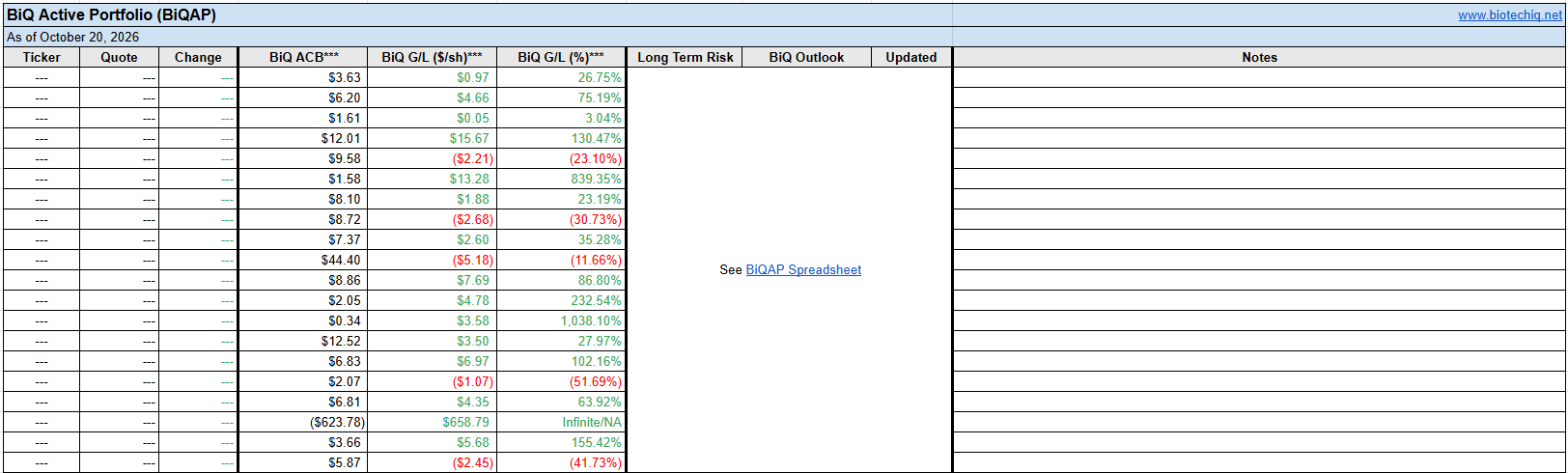
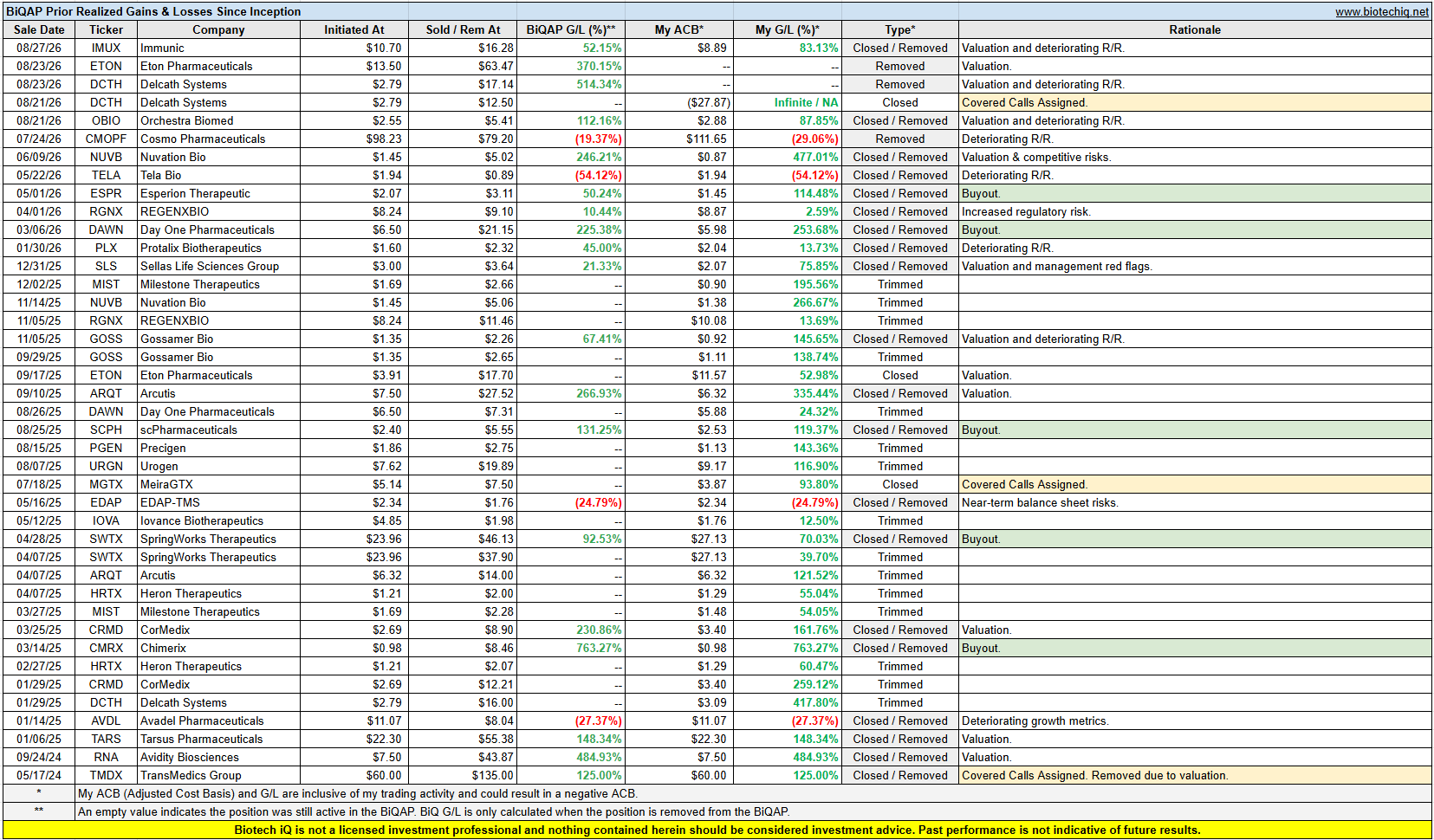
Please note that the BiQ ACB (adjusted cost basis) includes shares and all open options positions, which are accounted for using a "worst case scenario" assumption, plus realized trading profits (and losses) around my core position.
Not a BiQ Premium member, or have a friend who may be interested? Try BiQ Premium for $50 per month, or $375 (25% off) for the first year.
Biotech iQ is 100% subscriber supported. If you find this information helpful, please spread the word. You can also follow me on X @ Biotech iQ (_Biotech_iQ).
Biotech iQ is not an investment professional, and nothing on this page or this website should be considered investment advice. Please consult with a licensed investment professional as necessary. Past performance is not indicative of future results.
Section 3: Premium Member Section & Weekly Discussion Topics
The Paid Member Section includes additional discussion of key topics, portfolio updates, and my trading activity over the past week.