BiQ: Biotech Weekly Recap for 11/22/26
Many of the topics in this Weekly Recap were first discussed in BiQ Chat, our members-only Discord group. If you are a Premium Member and haven't already joined, you can find instructions here.
Not a BiQ Premium Member yet? You can join for 25% off your first year. If you'd rather try BiQ before committing to a full year, we also offer monthly memberships. Just click the Subscribe button on the biotechiq.net home page to see all the options.
One quick note to readers: Going forward, I will be splitting the Weekly Recaps into a biotech edition and a separate edition for our non-biotech names. This is mostly to keep the Recaps from getting too long and to help members focus on the information that matters most to them.
Market Overview: Biotech Bent, but Still Held Up Better
XBI fell 6.9% last week to close at $140.18, its lowest level in roughly three months. That hurt, but it beat the broader market by a wide margin. The S&P 500 fell 8.6%, and the Nasdaq-100 (QQQ) lost roughly 10%.
The selling was driven by tech. AI names slid all week, and by Thursday the S&P 500 and Nasdaq were each down about 5%. Then on Friday, Nvidia fell 14% on a report that US regulators are investigating its accounting. QQQ dropped another 5.7%, SPY fell 3.6%, and XBI lost 2.7%, closing below its 200-day moving average. The S&P 500 has now fallen seven straight sessions and is officially in correction territory.
XBI wasn't spared, but the damage was muted compared with the other indexes, and most of it landed on the more speculative names. Many watch-list names lost 20% or more on no news. Commercial-stage names held up a little better. CBLL, RARE, and URGN actually finished the week higher, and several watch-list names like BBIO, ROIV, and TGTX fell only 2% to 4%.
There were some bright spots in sector news. Bloomberg reported that Sanofi is weighing a takeover of Insmed, sending INSM from $120 to $144 in a day. The FDA also approved several new drugs, including Regeneron's Livsayis for generalized myasthenia gravis and GSK's Nelkarmi for lung cancer, the second drug from its Nuvalent acquisition.
OMER: Q3 Earnings
Omeros reported Q3 results after the close on Monday, and the stock fell 24% for the week. YARTEMLEA net revenue grew 26% from Q2 to $35.9 million, which missed the $37.3 million consensus. On the other hand, non-GAAP EPS of $0.06 beat expectations for a loss, and the company generated $13.3 million in operating cash flow. See the Premium Members section for our full earnings analysis.
Green Despite the Selloff: CBLL, RARE, STXS, and URGN
CBLL finished the week up 5% and is trading within about 5% of its 52-week high, which is impressive in a week like this. There was no new company news. The stock is still riding a strong Q3, when revenue grew 30% to $29.3 million, and Ceribell raised its full-year guidance to $115–117 million.
RARE (+3.8%), STXS (+13.5%), and URGN (+15.2%) also rose. I consider all three to have been oversold heading into the week:
- RARE is still near the low end of its 52-week range ($12.73 to $39.89), despite meaningful progress on costs. In October, it sold two priority review vouchers for a combined $413 million in non-dilutive funding. More importantly, management provided a coherent path to self-sustaining cash flow on the Q3 earnings call.
- URGN posted $68.0 million in Q3 ZUSDURI revenue, up 35% from Q2, and management expects to turn profitable and cash-flow positive in Q4. Its next-generation bladder cancer drug, UGN-103, has a PDUFA date of June 14, 2027. The stock did, however, give back about 13% on Friday.
- STXS still faces significant headwinds until it sorts out its catheter manufacturing issues. About $1.9 million in disposable orders were unfilled at the end of Q3 because of supply constraints, and recurring revenue slipped to $5.9 million from $6.2 million in Q2. The balance sheet is thin as well: cash was $4.0 million at September 30, before a surprise $12 million convertible note financing in November.
Speculative Names Took the Brunt of the Damage
Many of our more speculative names were down hard on no material company-specific news. In each case below, the most recent news predates the selloff, and nothing changed with the underlying story last week.
- VSTM (−22.6%): Coming off October's VS-7375 data and a $250 million raise. A Phase 3 trial in first-line pancreatic cancer is planned to start by year-end.
- AUTL (−21.8%): Q3 AUCATZYL revenue rose 95% to $41.2 million, and 2026 guidance was nudged to the top of the $140–150 million range. Oral presentation at ASH in December.
- NKTR (−18.1%): All three ZENITH Phase 3 trials in atopic dermatitis are underway, with the alopecia areata trial starting in December. Cash was $952.9 million at September 30.
- WVE (−16.9%): Presented interim INLIGHT data for WVE-007 at ObesityWeek on November 15. The stock is now at its 52-week low as we wait for data from the 600mg cohort for WVE-006.
- NRIX (−16.3%): Still digesting Sanofi's early-November exit from the STAT6 degrader program. New bexobrutideg data at ASH on December 13.
- KYTX (−13.9%): Completed its BLA for miv-cel in stiff person syndrome on November 12, requesting priority review.
- PRME (−13.8%): Now trading right around its $3.50 offering price from earlier this month. Cash funds operations through 2027.
- MGTX (−12.8%): No new or recent company news.
HELP: Positive Phase 3 APPROACH Data
Helus reported positive topline results from APPROACH, the first of two pivotal Phase 3 trials of HLP003 as an add-on treatment for major depressive disorder. The trial hit its primary endpoint with a wide margin and showed a rapid, durable effect:
- Primary endpoint: At Week 6, MADRS scores fell 19.5 points on HLP003 versus 11.9 on placebo, a 7.6-point placebo-adjusted difference (p<0.0001).
- Fast onset: The separation from placebo showed up as early as Day 2.
- Durability: At Week 12, the placebo-adjusted difference was still 7.0 points (p<0.0001).
- Response and remission: At Week 6, 56% of HLP003 patients responded versus 28% on placebo, and 51% were in remission versus 18%.
- Safety: HLP003 was generally well tolerated, with most side effects mild to moderate and limited to the dosing day. There were three treatment-related serious adverse events and no new safety signals.
The trial enrolled 222 patients who stayed on their existing antidepressant. Data from EMBRACE, the second pivotal trial, are expected in Q4 2027, which would set up a potential NDA filing in 2028.
Despite the clean result, HELP shares fell 21% on Monday and finished the week down 32%. See the Premium Members section for more on the data and my take on the selloff.
Stock theses, catalyst tracking, our portfolio and trades, and BiQ Chat.
CAPR: Second CRL for Deramiocel
Capricor received another Complete Response Letter for deramiocel, its cell therapy for Duchenne muscular dystrophy. The news came after the close on Friday, two days ahead of the November 22 PDUFA date, so the stock hasn't reacted yet. CAPR had already fallen 19% during the week.
According to Capricor, the FDA said the data are not sufficient to establish "substantial evidence of effectiveness." The letter also cites other clinical deficiencies, which the company did not detail. CEO Linda Marbán said the company stands behind its data, noting that both the HOPE-2 and HOPE-3 trials met their primary endpoints. Capricor is reviewing the letter and will share next steps once that evaluation is complete. It is hosting a conference call Monday at 8:30 a.m. ET.
The outcome isn't a total shock. This is the second rejection, following a CRL in July 2025, and an FDA advisory committee voted 9–3 against deramiocel's effectiveness in July 2026. Capricor had about $198.5 million in cash as of September 30, enough to fund operations for at least 12 months, and it is reviewing costs to stretch that runway.
I never considered CAPR derisked enough to add to the Core Biotech Portfolio, but I did share my personal trades with members in BiQ Chat at the time. We entered near the lows in late 2025 and exited shortly after the HOPE-3 data came out, for close to a 10x return. Here's my article from late 2025, before the HOPE-3 results: BiQ: 11/25/25 The Deramiocel Debate (CAPR).
After digging into the HOPE-3 data, however, I became less confident in approval, which is why I exited shortly afterward. Still, I had hoped deramiocel might eventually help patients living with this devastating disease. Sadly, while last week's CRL is unfortunate, it wasn't wholly unexpected.
ISRG: The Competition Is Closing In
ISRG fell 10% last week, and part of that was a reminder that da Vinci no longer has the US soft tissue market to itself. On Tuesday, Medtronic's Hugo robot was cleared for general surgery, the third major competitive milestone in under a year. For more than two decades, Intuitive had the only cleared soft tissue robot in the US.
- Nov 17, 2026 – Medtronic Hugo: FDA clearance for general surgery, including gallbladder removal, gastric bypass, ventral and inguinal hernia repair, small bowel resection, and appendectomy. Medtronic says these procedures total about 3.5 million US surgeries a year.
- Oct 12, 2026 – Stryker / CMR Surgical Versius: Stryker is investing about $400 million in CMR, becoming the exclusive US sales agent for Versius, with an option to buy the whole company.
- Jul 22, 2026 – J&J Ottava: FDA De Novo authorization for 10 upper-abdominal general surgery procedures. Ottava is the first robot built into the operating table, and J&J is starting with a limited launch to select customers.
- Dec 2025 – Medtronic Hugo: First FDA clearance for urologic procedures such as prostate removal. Hugo became the first robot from a large medtech company to reach the US soft tissue market since da Vinci launched in 2000.
The common thread is general surgery. That is where the procedure volume is, and it has been one of Intuitive's biggest growth drivers, especially after-hours cases like gallbladder removal and appendectomy. Medtronic and J&J are going straight at it, and both bring decades of existing relationships with general surgeons.
Intuitive is still the clear leader. It placed 546 da Vinci systems in Q3 and has more than 12,000 installed worldwide. Oppenheimer's field checks also flagged workflow challenges with Ottava and noted that Hugo takes up more operating room space than da Vinci. Still, US da Vinci procedure growth slowed to 10% in Q3, down from 12% in Q2 and 14% in Q1. Intuitive is also cutting its instrument and accessory revenue per procedure by 3% to 5% to drive adoption in high-volume procedures. That reads, at least to me, as a move to defend its turf as competitors arrive.
MRNA: Cooling Off After a Spectacular Run
After its spectacular rise this year, MRNA has logged its longest losing streak since 2024. The stock fell 10% last week to $195 and is now about 30% below its November 9 high of $280.80. Even so, it's still up more than eightfold from its 52-week low.
The pullback started with the November 12 Analyst Day. Moderna raised its 2026 revenue growth forecast to 15–25%, but it also guided to about $4 billion in cash costs in 2027 and $4–4.5 billion a year through 2030, mostly for oncology. That spending is tied to intismeran, the melanoma vaccine partnered with Merck, which cut the risk of recurrence or death by 42% in Phase 3. With the stock up so much this year, investors seem to have taken the higher spending as a reason to lock in gains.
Is the president's $16.9 million share sale material? I don't necessarily think so. Stephen Hoge sold 78,375 shares on November 16–17 for about $16.9 million. The sales were made under a pre-arranged Rule 10b5-1 trading plan, and they follow the same pattern as his sales in mid-September and mid-October: roughly 39,000 to 40,000 shares around the middle of each month. Each sale was only about 2% to 3% of his holdings, and he still owns well over a million shares. Insider selling has picked up compared with Moderna's usual pace, but that's not unusual after a stock rises this much, and none of it has been discretionary. For now, I'd treat it as noise rather than a signal.
UNH: Hit by a CMS Audit Proposal
UNH fell 17.5% last week after CMS proposed a sweeping anti-fraud rule that would widen Medicare Advantage audits. The stock fell 5.4% on Tuesday and another 10.2% on Wednesday, its biggest one-day drop since January. The whole group sold off with it: Humana fell 13%, Elevance 7.6%, and CVS 5.2% on Wednesday.
The proposal, aptly named CRUSH, was published on November 16. Medicare Advantage plans get paid more for members with more documented diagnoses, and CMS audits a sample of medical records to check them. Under CRUSH, CMS would extrapolate audit findings across a plan's broader payments, going back to 2018 audits. CMS estimates the rule could save nearly $90 billion over 10 years. That hits UNH harder than anyone, since it is the largest Medicare Advantage provider.
The rule isn't final. Comments are open until January 19, 2027, and Oppenheimer expects legal challenges, noting that a federal court rejected a similar framework in 2025. Most of the savings would come from clawing back past payments in 2028 through 2030. If the rule survives, Oppenheimer expects insurers to pass the cost into future plan bids rather than absorb it in earnings.
Stock theses, catalyst tracking, our portfolio and trades, and BiQ Chat.
Section 2: Core Biotech Portfolio Performance
To view full portfolio performance across our entire portfolio of biotech and non-biotech names, including the related tickers, members can click here for the complete spreadsheet.
Portfolio Performance represents the gain/loss in the share price during the holding period.
My Performance represents my personal performance, which includes options and trading income realized during the holding period.
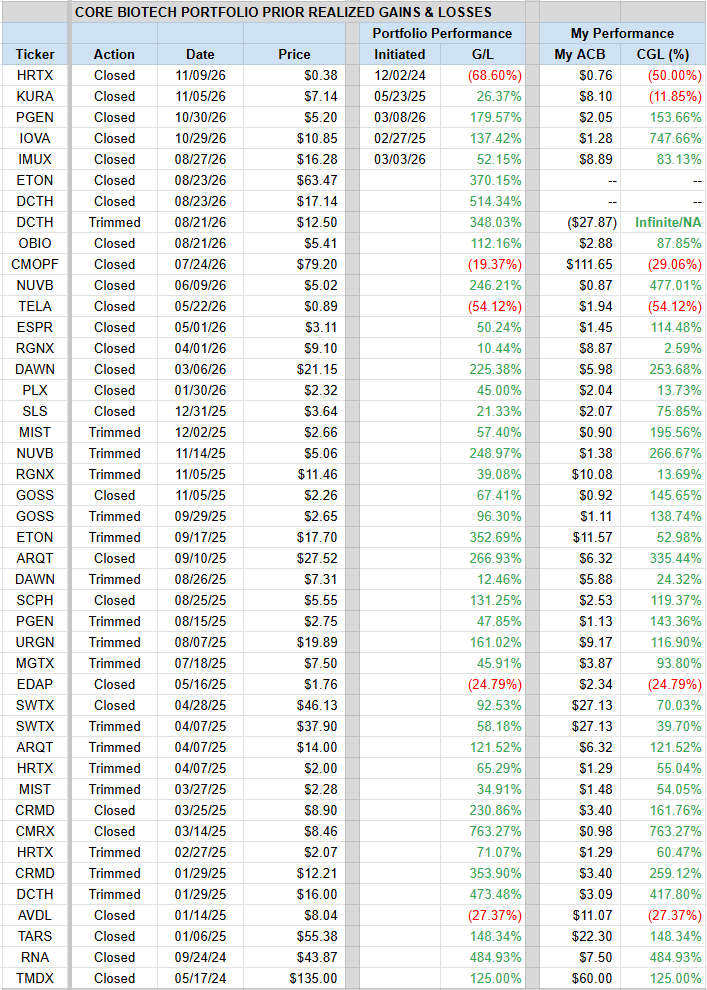
Please note that the BiQ ACB (adjusted cost basis) includes shares and all open options positions, which are accounted for using a "worst case scenario" assumption, plus realized trading profits (and losses) around my core position.
Not a BiQ Premium member, or have a friend who may be interested? Try BiQ Premium for $50 per month, or $375 (25% off) for the first year.
Biotech iQ is 100% subscriber supported. If you find this information helpful, please spread the word. You can also follow me on X @ Biotech iQ (_Biotech_iQ).
Biotech iQ is not an investment professional, and nothing on this page or this website should be considered investment advice. Please consult with a licensed investment professional as necessary. Past performance is not indicative of future results.