BiQ: Weekly Recap for 11/15/26
Most of the information in this Weekly Recap has already been discussed in the BiQ Chat forum. I encourage members who haven't joined BiQ Chat yet to join our Discord group. Instructions can be found here.
This week's discussion topics for Premium members include the following:
- Abeona Therapeutics Q3 Earnings and the ABO-801 Acquisition. Where Does Abeona Go From Here?
Section 1: Selected Weekly Highlights
Biotech
Prime Medicine (PRME)
Prime Medicine reported Q3 on Wednesday. The quarter was a modest beat — a loss of $0.22 a share against consensus of $0.23 to $0.24, revenue of $4.2M, operating expenses of $44.1M, and a net loss of $39.0M. Expenses were down 20% year over year, though most of that is lapping a one-time stock charge rather than real belt-tightening; strip it out and R&D fell about 5.5%.
None of this, however, really matters for PRME. What actually matters is that Prime ended September with $61.2M in unrestricted cash against roughly $37M of quarterly burn — under two quarters of runway heading into a year with two first-in-human programs. So on November 10, the company priced 41.1M shares at $3.50, including the full underwriters' option, raising $143.75M gross and about $134.7M net. That is 22.6% dilution at a price 18.6% below the prior close. The deal closed the same day results came out, and the stock finished Wednesday at $3.89, down 9.5%, but above the offering price.
Post-offering, pro forma cash is roughly $209.5M, of which about $195.9M is usable after setting aside restricted cash pledged against leases. Management's guidance moved from "into 2027" to "through 2027." That is around five quarters at the current burn, and fewer once spending ramps. Clinical expense was only $2.1M this quarter, about 6% of R&D. With two Phase 1/2 trials and a BLA to build, $37M a quarter should be considered a floor--not a sustainable run rate.
So the raise bought a year, not a comfortable cushion. What would actually change the setup is money that does not cost shareholders anything, and there are three places it could come from.
The first is a partnership. Matthew Hawryluk joined as Chief Business Officer a year ago, coming from AIRNA — an RNA-editing company, where he ran corporate and business development, finance, and legal and helped land an oversubscribed $155M Series B — after nearly a decade as EVP and Chief Business Officer at Gritstone Bio and a stint leading corporate development at Foundation Medicine. That is a dealmaker's resume, and he has now had twelve months to build a pipeline of conversations. The universal liver LNP, the CF program, or ex-US rights are all partnerable.
The second is Bristol Myers Squibb. The CAR-T collaboration still carries $59.8M of unsatisfied transaction price on the balance sheet, with development milestones running to roughly $1.4B inside a deal worth more than $3.5B in total. None has been disclosed as earned. One milestone would be material against a $195M cash position.
The third is PM359. The CGD program holds RMAT, Fast Track, Orphan Drug, and Rare Pediatric Disease designations, with a BLA planned for the first half of 2027 pending final FDA alignment. It would be the first prime editing BLA anywhere, and the pediatric designation puts a priority review voucher in play — those have historically sold around $100M. Worth noting, the offering prospectus names Wilson and AATD as the primary uses of proceeds and does not mention PM359, which raises a fair question about how the filing will be funded.
The biggest value unlock, however, is likely to be early data for the Wilson Disease program. On October 5, Prime dosed the first patient in the global Phase 1/2 of PM577a — the first human ever dosed with an in vivo prime editor. Initial data are expected in 2027. This readout carries more than one program. PM577a and PM647 share the same universal liver LNP and the same editor architecture, so Wilson is the first human read on both the delivery vehicle and the editing chemistry. Clean safety with meaningful copper correction de-risks the entire liver franchise in a single print. A problem, on the other hand, would take both programs down together.
One interesting question is how big Wilson actually is. PM577a targets H1069Q, the most common disease-causing variant in North America and Europe. A follow-on, PM577b, targets R778L and is in preclinical work. Same LNP, different guide — that is the modularity argument being exercised rather than merely asserted. What makes that more than a line extension is the FDA's October 27 draft guidance on individualized genome editing products. It introduces the idea of an Individualized Feature Space: pre-defined limits of allowable variation in the edited components, so one application can cover several versions of a therapy as long as each targets the same gene and produces the same editing outcome. For a platform where the delivery vehicle is fixed and only the guide changes, that reads as close to purpose-built for PM577 as one could hope for. Comments close November 27.
If it lands in something like its current form, Wilson shifts from a single-genotype opportunity toward a pan-genotype one without a separate BLA per variant. The disease affects more than 50,000 people across commercially accessible geographies, and ATP7B carries hundreds of pathogenic variants, with most patients being compound heterozygotes. Covering more of that distribution materially changes the commercial math.
The competitive field also just cleared. Ultragenyx terminated UX701, its AAV gene therapy for Wilson disease, in early November after a fourth dose-finding cohort failed to meet the criteria to advance to Phase 3—announced alongside a roughly 20% workforce reduction. That removes the most clinically advanced genetic medicine competitor in the indication.
There is, of course, another way to read the UX701 termination. Four cohorts of an AAV gene therapy could not clear the efficacy bar. Wilson patients are stable on chelation, which sets a high safety bar for a permanent edit, and copper endpoints move slowly. In its favor, Prime is attacking the mutation rather than delivering a transgene, so it is a genuinely different shot.
Moving on to AATD, the FDA cleared the PM647 IND in September. The trial is global, single-arm, and open-label, starting with lung-only patients and adding a liver cohort once tolerability is established, with initial data in 2027.
Entering against Beam, which has been dosing a pivotal cohort since July and has FDA alignment on accelerated approval using 12-month biomarkers, needs a reason. There are two that I think are worth taking seriously.
The first is efficacy. Prime's preclinical work showed up to 72% precise correction of SERPINA1 in hepatocytes of fully humanized mice, with over 95% of serum AAT as the corrected isoform and M-AAT above 20µM. Beam's human numbers at its selected 60 mg dose are 16.1µM mean steady-state total AAT, 94% M-AAT composition, and an 84% reduction in mutant Z-AAT. Those are not comparable — humanized mouse against human, different assays — and presenting them as a head-to-head would be overreaching and misleading. What they do suggest, however, is that prime editing's usual efficiency penalty relative to base editing may not apply here, which is the standard objection to this program. Call it a hypothesis with at least some supporting evidence.
The second argument is stronger (IMO). A base editor converts A to G across roughly a five-base window, so other adenines sitting in that window can be converted too. Beam's own work documented exactly this: alongside precise correction, significant linked bystander editing appeared in patient fibroblasts, with D341G the second most abundant allele.
The redosing implication is specific and, I think, underappreciated (which also relates to comparisons with WVE-006, but we won't cover that here). Correcting E342K does not destroy the protospacer, so a second dose re-engages alleles that are already corrected — and the only thing an editor can do to a corrected allele is convert its neighbor. Uncorrected alleles can improve; corrected ones can only degrade. A prime editor writes from a template, so re-engaging a corrected allele writes wild-type onto wild-type. Base editing ratchets. Prime editing is idempotent.
Beam's own multi-dose cohort is at least consistent with that. Two 60 mg doses produced 16.5µM total AAT against 16.1µM for a single dose, with M-AAT at 93% versus 94% and Z-AAT reduction at 80% versus 84%. Double the exposure bought 0.4µM, and both composition metrics drifted backward. Beam reads this as near-saturation editing, which is plausible and possibly right — but saturation predicts no change, not a mild reversal, and three patients with mismatched timepoints cannot settle it.
The harder fact for Beam is safety on re-exposure. In that three-patient cohort, all three had events after the second dose, including one Grade 4 ALT with Grade 3 AST and Grade 2 infusion reactions — against 26 single-dose patients with no serious adverse events and no dose-limiting toxicities up to 75 mg. Redosing is where their profile breaks.
Prime's LNP may help here. It carries a GalNAc targeting ligand, routing uptake through ASGPR rather than the LDLR pathway conventional liver LNPs rely on, and the company reports better potency, safety, and biodistribution against other clinical-stage LNPs with clean liver function tests, IL-6, and histopathology in rodent and NHP studies. The mechanism is credible: better targeting means less lipid for the same editing, and lipid dose drives much of what causes infusion reactions.
But that is preclinical, self-reported, and the comparators are unnamed. Prime has no human exposure data for this LNP at all — Wilson is the first. And Beam's delivery only fails on re-exposure, so the bar is not "safer LNP" but "tolerates a second dose," which nobody has shown clinically (yet) for Prime. PM647's disclosed design is a one-time infusion with ascending doses and no multi-dose arm, so the company is not currently set up to generate that evidence. For now, the redosing case is a platform argument, not a label differentiator.
I remain bullish long term, and glad the raise is behind us. Carrying $61M into a year with two first-in-human programs was not tenable, and some form of financing activity was expected. Taking $3.50 with the rally still intact beat whatever the alternative looked like six months from now. The dilution stings, but it's par for the course for early-stage, small-cap bios. What matters is if the capital is used to build long-term value.
Despite the offering, the runway is still thin. Five quarters at best, less once the trials ramp, with going-concern language the raise did not clear and an annual report in March that will test it again. Over the next six months, I'd like to see non-dilutive capital — a BMS milestone, a platform or regional licensing deal, or a partner on PM359. Any one of them changes the financing conversation ahead of the 2027 data, not after it. That would be the difference between showing data from a position of strength versus having to raise into it.
In my view, the catalysts justify the wait. Wilson is the first human read on in vivo prime editing and validates or breaks the liver franchise in one print. AATD is a second shot with a genuinely differentiated mechanism. PM359 could be the first prime editing BLA anywhere. At roughly $670M enterprise value, I don't see much of that in the price.
Please see the BiQAP spreadsheet for my current buy targets for PRME.
Avita Medical (RCEL)
I’m glad to see AVITA Medical (RCEL) turning the corner. I’ve always believed in RECELL as a technology. The problem was never the product; it was that the company couldn’t find the right commercial path, and 2025 landed with reimbursement disruption, guidance cuts, and a stock that kept falling. The recent Q3 looks like a different company. Revenue came in at $26.11 million against expectations of $22.35 million, up 53% year over year and 20% sequentially. Gross margin rose to 84%. Management also raised full-year guidance to $92 million to $94 million, from $86 million to $89 million, its second raise this year.
Much of the credit goes to CEO Cary Vance and his team. He was named interim CEO on October 16, 2025, the same day the company said Q3 2025 revenue would come in around $17 million, short of the $19.2 million analysts expected. The board made him permanent president and CEO after an April search. Since then, he has refinanced the debt and narrowed the company’s focus. He has also held operating expenses flat at about $24.5 million for four straight quarters while quarterly revenue climbed from $17.6 million to $26.1 million. That’s real operating leverage: the operating loss shrank to $2.6 million from $9.2 million a year ago. U.S. RECELL units rose 22% sequentially at stable pricing, so the growth is coming from volume, not price increases.
Cohealyx and PermeaDerm matter more than their current revenue suggests. Together with RECELL, they cover the whole wound-care process: PermeaDerm protects the wound, Cohealyx rebuilds the wound bed, and RECELL restores the skin. That gives hospitals a meaningful reason to standardize on AVITA and makes the company less dependent on RECELL alone, which still accounts for about 89% of revenue. Cohealyx sales grew 154% year over year to $2.1 million – small, but growing fast. The PermeaDerm-I study was the standout: results showed comparable graft take and wound healing to allograft, with 70% lower product cost and 95.7% less preparation time.
There were also other positives during the quarter:
- CMS finalized national physician payment rates and new Category I CPT codes, effective January 1, 2027. That puts the reimbursement confusion that derailed 2025 behind the company.
- The going-concern warning has been removed, and the auditor agreed.
- AVITA drew an extra $10 million from its lender after trailing revenue passed $85 million.
- Full six-month Cohealyx-I data is due shortly.
The path to self-sustaining cash flow is now becoming clearer. Net cash use fell to about $0.6 million in Q3, from $9.9 million in Q1, and management reaffirmed cash-flow breakeven for Q4. RECELL margins are around 88%, and spending should stay roughly flat into 2027, so most new revenue should flow to the bottom line. AVITA’s share of Cohealyx revenue also rises from 50% to 60% in 2028. To be fair, Q3 cash got some help from accrued bonuses, and Q1 typically uses more cash. I’d look for durable breakeven once quarterly revenue reaches the high-$20 million range, likely in the first half of 2027. I remain bullish, but I wouldn’t be surprised by a near-term pullback. The stock is up roughly fivefold from its lows, and the new guidance implies Q4 revenue of $24.9 million to $26.9 million, roughly flat with Q3 at the midpoint. In my opinion, a pause here would be a consolidation of a big move, not a broken thesis.
Please see the BiQAP spreadsheet to view my current buy targets for RCEL.
Stereotaxis (STXS)
Stereotaxis (STXS) had a disappointing third quarter, and nearly all of the disappointment traces back to one problem: the company still can't get enough MAGiC catheters. Revenue grew 20% year over year to $8.9M, but that was roughly $1M short of the ~$10M management guided to in August, and the entire miss came from recurring revenue. The stock took it hard, falling to around $0.85, near its 52-week low.
My read is that the market is pricing a supply problem as if it were a demand problem. The recurring business is currently supply-gated, not demand-gated, and the company exited the quarter with orders it simply couldn't fill. That doesn't make the quarter good, and the balance sheet is now the main thing standing between Stereotaxis and the payoff on its platform.
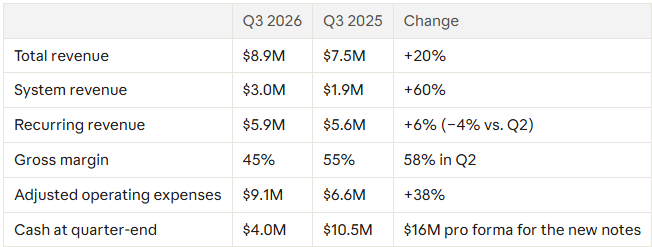
Systems came in right where management said they would, helped by partial revenue recognition on the first U.S. GenesisX sale, the first Genesis system sold in China, and the first full quarter of Synchrony sales. Recurring revenue was the problem: about $5.9M against the ~$7M guided, and down sequentially. The entire miss, and then some, was attributable to the catheter supply shortfall.
Margins took a hit as well. Fixed manufacturing overhead spread over low production volumes pushed recurring gross margin down to 59% (from about 66%) and system gross margin to 15%, and management expects margins to stay near these levels in the near term. Operating expenses were inflated by one-time Robocath closing costs; management says to model about $8M a quarter going forward.
The clearest evidence of this being a supply issue, not a demand issue, is the backlog. Stereotaxis entered Q4 with about $1.9M of disposable orders it couldn't fill, roughly a third of a full quarter's recurring revenue. That isn't what a demand problem looks like.
The bottleneck is Osypka, the German contract manufacturer that builds MAGiC. Its Q3 output was essentially flat with Q2, and the 500-catheters-a-month year-end target management laid out earlier this year is clearly off the table. The explanation on the call was thin. CEO David Fischel said the manufacturer had an early ramp followed by setbacks, mainly around production yields and hiring skilled staff, but he gave no production numbers, no recovery plan from Osypka, and no detail on the contract. For a company whose recurring revenue depends on a single outside manufacturer, I'd have liked a lot more.
Management is working around it on two fronts:
- Europe: Over the summer, European sites were switched to two other robotic magnetic catheters that Stereotaxis distributes under exclusive agreements, freeing up every MAGiC for the U.S., where it is the only option. Management expects Q4 recurring revenue to be a "high watermark" even with no improvement at Osypka, and roughly half of the backlog to clear in Q4. The alternative magnetic catheters, however, carry even lower margins than the company's own MAGiC catheters, which is probably another factor that weighed on Q3 margins.
- Redundant supply: The more important fix is a second source of MAGiC supply. Management wouldn't say who or what it is (Fischel said he would describe it only vaguely), but expects the regulatory decisions that enable it in early 2027. A related regulatory milestone is expected within about a month, which also unlocks the second $12M of the new financing. The company is building inventory now so it can clear the U.S. backlog within days of approval.
To be fair, it isn't all about supply. Some sites are still working through a difficult transition away from the Johnson & Johnson catheter ecosystem, and pulsed field ablation is soaking up a lot of electrophysiologists' attention. But if the redundant supply arrives on schedule, the first half of 2027 should be the first time recurring revenue actually reflects demand.
I continue to think Stereotaxis is undervalued on the strength of its technology and platform. Four pieces stand out to me:
- GenesisX. This is the system that changes the capital sales story. It needs no room construction, and in August it was FDA-cleared to work with unmodified X-ray systems; every previous Stereotaxis robot required a specific modified X-ray. Canon signed a compatibility and co-marketing collaboration in late October. The first U.S. GenesisX goes into an academic medical center this month, the first European system follows soon after, and another is lined up for early 2027 with a different major X-ray vendor. Management puts the pipeline at a couple dozen opportunities.
- Robocath. Acquired in July, Robocath gives Stereotaxis a second robotic mechanism: a mechanical robot that manipulates multiple devices at the bedside, aimed at coronary and neurovascular procedures. At TCT, its next-generation system (R-Star) reported a 20-patient first-in-human study with 100% clinical success, 19 of 20 procedures completed fully robotically, and no device-related adverse events through 30 days. The plan is design freeze, supply chain, and U.S. and European regulatory submissions within roughly two years of the deal.
- In-house catheter development. Stereotaxis designs its own interventional catheters (MAGiC and the MAGiC Sweep mapping catheter today, with robotic pulsed field ablation and robotically steered guidewires in development), and that is where the razor-blade economics come from. Robotic catheter revenue grew more than 400% year over year and should reach several million dollars in 2026, versus a few hundred thousand in 2025. Per management, MAGiC is the only FDA-approved ablation catheter for congenital heart disease patients. The Q3 lesson is that design expertise isn't enough when manufacturing is outsourced to a single supplier, which is exactly why supply redundancy matters.
- A broad set of indications. Between the magnetic robots, Robocath, and the catheter pipeline, Stereotaxis has a credible path into electrophysiology (including pediatric, congenital, and ventricular arrhythmias, where PFA isn't penetrating), coronary intervention, and neurovascular procedures. Synchrony, its digital operating room system, adds a capital line that sells into non-robotic cath labs. It is running at about $1M a quarter, and Abbott Northwestern has standardized all four of its cardiology cath labs on it.
At around $0.85, Stereotaxis has a market cap of roughly $86M, and enterprise value is about the same, since pro forma cash roughly matches debt. That is under 3x trailing revenue. Even counting the ~51M shares the Series A convertible preferred converts into, the market cap is about $130M. For two robotic platforms, a proprietary catheter portfolio and a disposable backlog, I think that's way, way too low. Stereotaxis remains in a transition phase; it hasn't quite "arrived" yet. It will be important to monitor its progress carefully.
Please see the BiQAP spreadsheet to view my current buy targets for STXS.
Zura Bio (ZURA)
Zura Bio is a position I held in the past, but I decided to take profits earlier this year as I no longer had high confidence in success. However, I received several questions about the name in mid-October after a prominent blogger posted his thesis on X. This was my reply from October 14th:
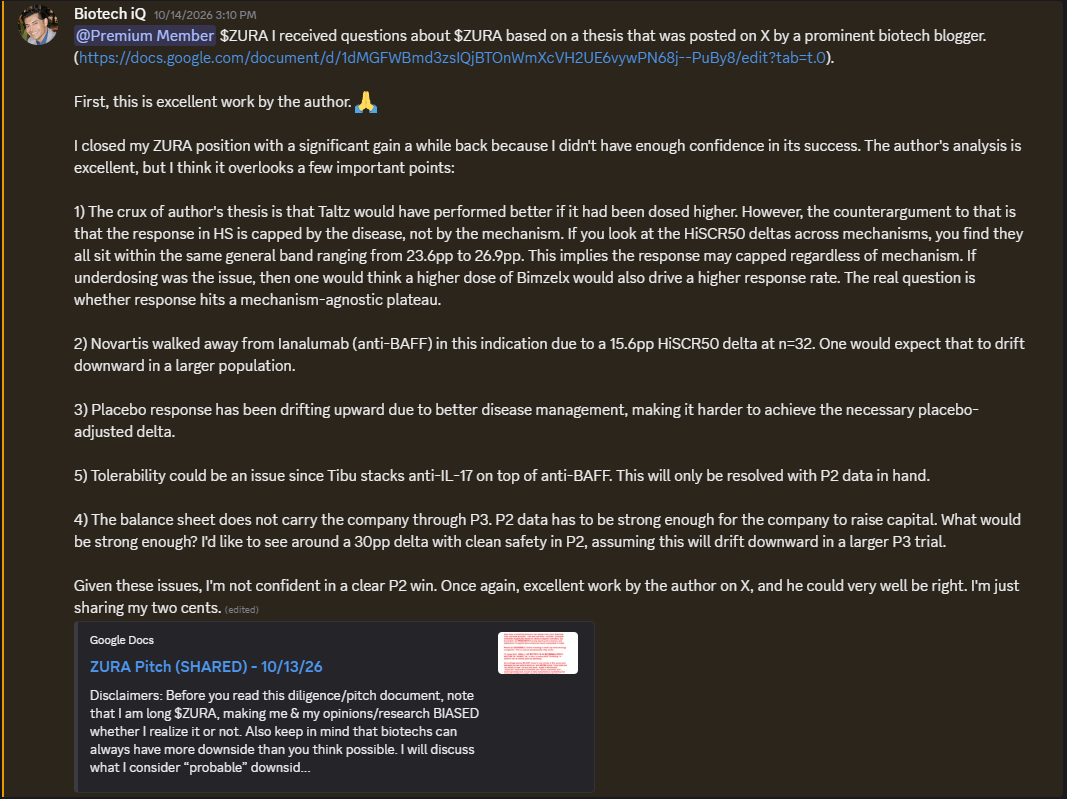
I think the author's 40+ page analysis was excellent and extremely thorough; however, I disagreed on a few key points. I can't say for sure whether it was for the reasons I outlined above, and quite honestly, the data readout could have gone either way, but Tibulizumab's recent failure in HS collapsed the share price to under $1.25. The question I've received from some readers now is whether I think ZURA is worth owning at the current valuation. I no longer follow Zura closely, but in my opinion, the PoS still looks too low to me to support owning the name.
Section 2: Core Biotech Portfolio Performance
To view full portfolio performance across our entire portfolio of biotech and non-biotech names, including the related tickers, members can click here for the complete spreadsheet.
Portfolio Performance represents the gain/loss in the share price during the holding period.
My Performance represents my personal performance, which includes options and trading income realized during the holding period.
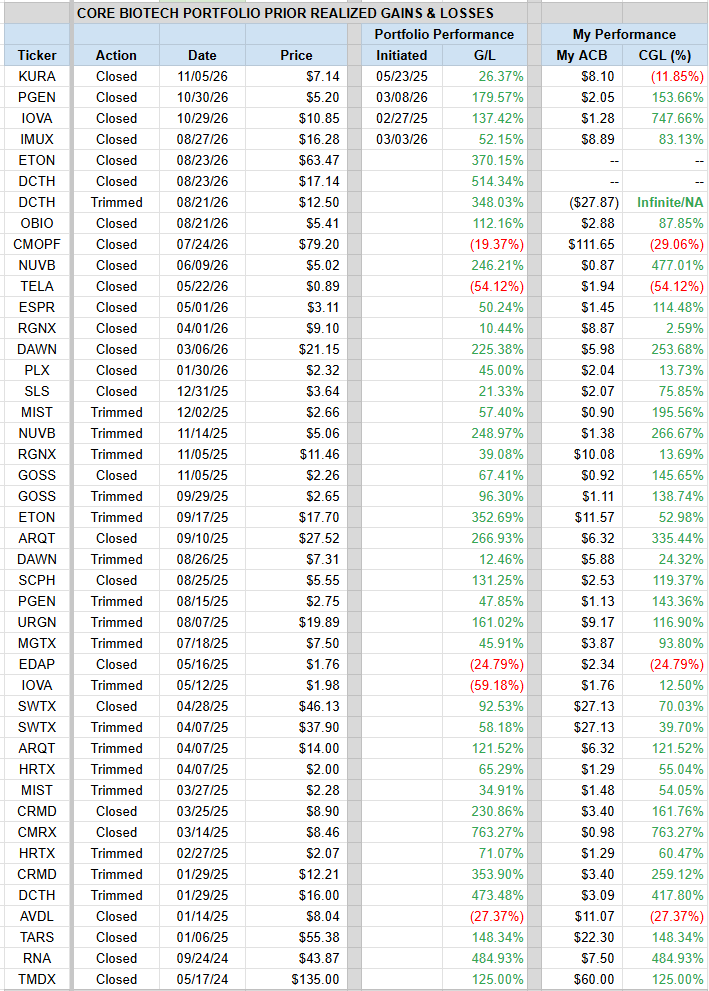
Please note that the BiQ ACB (adjusted cost basis) includes shares and all open options positions, which are accounted for using a "worst case scenario" assumption, plus realized trading profits (and losses) around my core position.
Not a BiQ Premium member, or have a friend who may be interested? Try BiQ Premium for $50 per month, or $375 (25% off) for the first year.
Biotech iQ is 100% subscriber supported. If you find this information helpful, please spread the word. You can also follow me on X @ Biotech iQ (_Biotech_iQ).
Biotech iQ is not an investment professional, and nothing on this page or this website should be considered investment advice. Please consult with a licensed investment professional as necessary. Past performance is not indicative of future results.
Section 3: Paid Member Section & Weekly Discussion Topics
The Paid Member Section includes additional discussion of key topics, portfolio updates, and my trading activity over the past week.